Antarctica - Beyond the Polar Circle - Whale Watching Cruise

Find the perfect trip

12 days from

£6314 GBP pp

* Current p/p indicative rate.

Overview
Highlights
Dates & Prices
Itinerary
Map
Ships

Highlights

  • Polar Diving - Visiting the polar regions is a fantastic adventure, but just below the waves waits an extraordinary other world for you to experience and explore.
  • Photography Workshop - Sharpen your photography skills in some of the planet’s most picturesque places.
  • Bird Watching - Enjoy birding together with fellow birders and visit remote places with rare bird species.
  • Deception Island - A volcanic island in the South Shetlands, north of the Antarctic Peninsula.
  • Adelie Penguin - These gallant-fighting, deep-diving namesakes of the French-claimed Antarctic Adélie Land are among the four penguin species on mainland Antarctica.
  • Chinstrap Penguin - Though armed with the "stonebreaker" nickname and a quarrelsome reputation, these gentoo relatives are fading from the Antarctic – probably due to climate change.
  • Gentoo Penguin - These hygienic divers are the only penguin species whose population is currently increasing along the Antarctic Peninsula.

Highlights

  • Polar Diving - Visiting the polar regions is a fantastic adventure, but just below the waves waits an extraordinary other world for you to experience and explore.
  • Photography Workshop - Sharpen your photography skills in some of the planet’s most picturesque places.
  • Bird Watching - Enjoy birding together with fellow birders and visit remote places with rare bird species.
  • Deception Island - A volcanic island in the South Shetlands, north of the Antarctic Peninsula.
  • Adelie Penguin - These gallant-fighting, deep-diving namesakes of the French-claimed Antarctic Adélie Land are among the four penguin species on mainland Antarctica.
  • Chinstrap Penguin - Though armed with the "stonebreaker" nickname and a quarrelsome reputation, these gentoo relatives are fading from the Antarctic – probably due to climate change.
  • Gentoo Penguin - These hygienic divers are the only penguin species whose population is currently increasing along the Antarctic Peninsula.
Ship Hondius
Capacity: 176, Type: Expedition
Feture image for Antarctica - Beyond the Polar Circle - Whale Watching Cruise

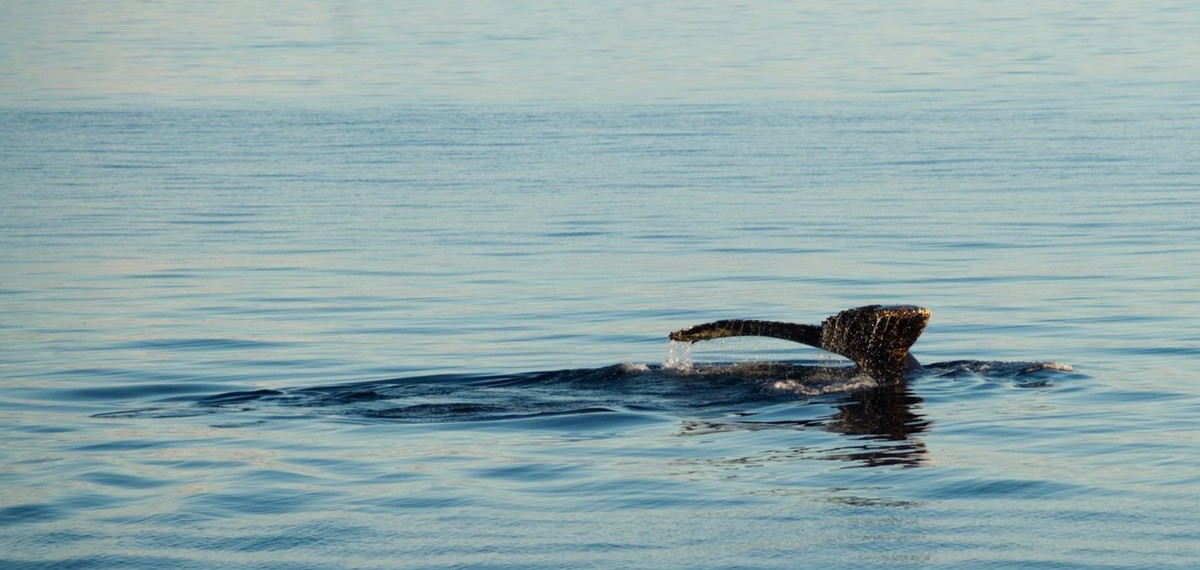
This Polar Circle and Antarctic Peninsula cruise passes through waters travelled by Humpback, Minke and Fin whales. Anchoring in various spots around the region, the expedition offers the chance to dive in the iceberg-heavy waters.

  • Polar Diving - Visiting the polar regions is a fantastic adventure, but just below the waves waits an extraordinary other world for you to experience and explore.
  • Photography Workshop - Sharpen your photography skills in some of the planet’s most picturesque places.
  • Bird Watching - Enjoy birding together with fellow birders and visit remote places with rare bird species.
  • Deception Island - A volcanic island in the South Shetlands, north of the Antarctic Peninsula.
  • Adelie Penguin - These gallant-fighting, deep-diving namesakes of the French-claimed Antarctic Adélie Land are among the four penguin species on mainland Antarctica.
  • Chinstrap Penguin - Though armed with the "stonebreaker" nickname and a quarrelsome reputation, these gentoo relatives are fading from the Antarctic – probably due to climate change.
  • Gentoo Penguin - These hygienic divers are the only penguin species whose population is currently increasing along the Antarctic Peninsula.

Availability is always subject to confirmation. Please check with us before booking flights

20 March, 2026 to 31 March, 2026 on Hondius
Prices

Prices quoted here are often dependent on currency fluctuations. Please check with (01432 507450 or info@small-cruise-ships.com) for the very latest price, which may well be cheaper than the one advertised here.
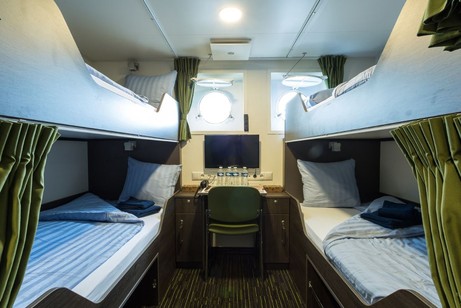
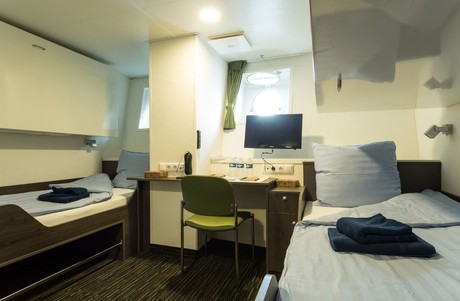
Quadruple Porthole
£6314 GBP pp
Quadruple Porthole
2 portholes 2 upper & lower berths Small sofa Private shower & toilet Flatscreen TV Desk & chair Telephone and WiFi Coffee & tea maker Hair dryer Cabinet Wardrobe Safe This cabin is suitable for families traveling with children, or passengers who do not require a twin or more luxurious cabin
Triple Porthole
£7161 GBP pp
Triple Porthole
2 portholes 1 upper berth & 2 lower berths Small sofa Private shower & toilet Flatscreen TV Desk & chair Telephone and WiFi Coffee & tea maker Hair dryer Cabinet Wardrobe Safe This cabin is suitable for families traveling with children, or passengers who do not require a twin or more luxurious cabin
Twin Porthole
£7816 GBP pp
Twin Porthole
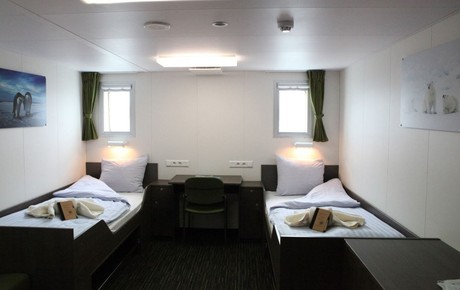
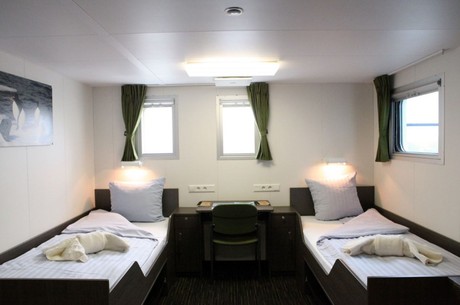
2 portholes 2 single beds Small sofa Private shower & toilet Flatscreen TV Desk & chair Telephone and WiFi Coffee & tea maker Hair dryer Cabinet Wardrobe Safe
Twin Window
£8200 GBP pp
Twin Window
1 window 2 single beds Small sofa Private shower & toilet Flatscreen TV Desk & chair Telephone and WiFi Coffee & tea maker Hair dryer Cabinet Wardrobe Safe
Twin Deluxe
£8855 GBP pp
Twin Deluxe
2 windows 2 single beds Sofa Private shower & toilet Flatscreen TV Desk & chair Telephone and WiFi Refrigerator Coffee & tea maker Hair dryer Cabinet Wardrobe Safe
Superior
£9471 GBP pp
Superior
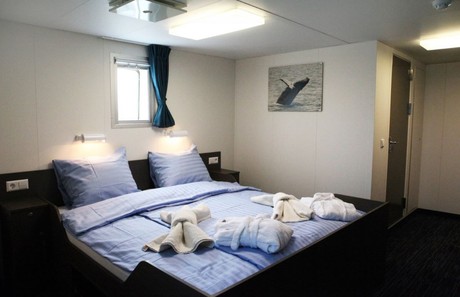
2 windows 1 double bed Sofa Private shower & toilet Flatscreen TV Desk & chair Telephone and WiFi Refrigerator Coffee & tea maker Hair dryer Cabinet Wardrobe Safe
Junior Suite
£9894 GBP pp
Junior Suite
1 double window 1 double bed Private shower & toilet Flatscreen TV Desk & chair Telephone and WiFi Refrigerator Coffee & tea maker Hair dryer Cabinet Wardrobe Safe
Grand Suite with Private Balcony
£11473 GBP pp
Grand Suite with Private Balcony
1 double window 1 double bed Sofa Private balcony Private shower & toilet Flatscreen TV Desk & chair Telephone and WiFi Refrigerator Coffee & tea maker Hair dryer Cabinet Wardrobe Safe
11 March, 2028 to 23 March, 2028 on Ortelius
Prices

Prices quoted here are often dependent on currency fluctuations. Please check with (01432 507450 or info@small-cruise-ships.com) for the very latest price, which may well be cheaper than the one advertised here.
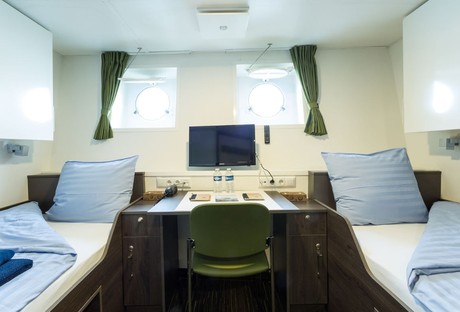
Quadruple Porthole
£9245 GBP pp
Quadruple Porthole
2 portholes 2 upper / lower berths Private shower & toilet Desk & chair Flatscreen TV Telephone & WiFi (supplemented) Hair dryer Ample storage space
Triple Porthole
£10435 GBP pp
Triple Porthole
2 portholes 1 upper / lower berth + 1 single lower berth Private shower & toilet Desk & chair Flatscreen TV Telephone & WiFi (supplemented) Hair dryer Ample storage space
Twin Porthole
£11399 GBP pp
Twin Porthole
2 portholes 2 lower berths Private shower & toilet Desk & chair Flatscreen TV Telephone & WiFi (supplemented) Hair dryer Ample storage space
Twin Window
£11825 GBP pp
Twin Window
2 windows 2 lower berths Private shower & toilet Desk & chair Flatscreen TV Telephone & WiFi (supplemented) Hair dryer Ample storage space
Twin Deluxe
£13169 GBP pp
Twin Deluxe
3 windows 2 lower berths Private shower & toilet Desk & chair Small sofa Refrigerator Coffee & tea maker Flatscreen TV Telephone & WiFi (supplemented) Hair dryer Ample storage space
Superior
£13825 GBP pp
Superior
2 windows (minimum) 1 double bed 1 single (sofa) bed Private shower & toilet Desk & chair Flatscreen TV Telephone & WiFi (supplemented) Refrigerator Coffee & tea maker Hair dryer Ample storage space
show reverse itinerary
Day 1: End of the world, start of a journey

Your voyage begins where the world drops off. Ushuaia, Argentina, reputed to be the southernmost city on the planet, is located on the far southern tip of South America. Starting in the afternoon, you embark from this small resort town on Tierra del Fuego, nicknamed “The End of the World,” and sail the mountain-fringed Beagle Channel for the remainder of the evening. 

Day 2 - 3: Path of the polar explorers

Over the next two days on the Drake Passage, you enjoy some of the same experiences encountered by the great polar explorers who first charted these regions: cool salt breezes, rolling seas, maybe even a fin whale spouting up sea spray. After passing the Antarctic Convergence – Antarctica’s natural boundary, formed when north-flowing cold waters collide with warmer sub-Antarctic seas – you are in the circum-Antarctic upwelling zone. Not only does the marine life change, the avian life changes too. Wandering albatrosses, grey-headed albatrosses, black-browed albatrosses, light-mantled sooty albatrosses, cape pigeons, southern fulmars, Wilson’s storm petrels, blue petrels, and Antarctic petrels are a few of the birds you might see.

Day 4 - 9: Sights of late summer Antarctica

Options for Antarctic Peninsula activities are many, and no less great during the late summer. Humpback whales are prolific in this region, gorging themselves on krill before their migration north. The penguin chicks are also fledging, stirring up activity on the beaches while sleek leopard seals lie in wait, poised to attack the less fortunate ones.
 
Sites for your Antarctic adventures may include: 
 
Livingston Island – Here you find a wide variety of gentoo and chinstrap penguins on Hannah Point, as well as southern giant petrels and elephant seals hauling out onto the beach. 
 
Deception Island – Actually a subducted crater, this island opens into the sea and creates a natural harbor for the ship. An abandoned whaling station, and multiple bird species – cape petrels, kelp gulls, brown and south polar skuas, and Antarctic terns – can be seen here. Wilson’s storm petrels and black-bellied storm petrels also nest in the ruins of the whaling station in Whalers Bay. 
 
Cuverville Island – A small precipitous island nestled between the mountains of the Antarctic Peninsula and Rongé Island, Cuverville houses a large colony of gentoo penguins and breeding pairs of brown skuas. 
 
Neko Harbour – An epic landscape of mammoth glaciers and endless wind-carved snow, Neko Harbour offers opportunities for a Zodiac cruise and landing that afford the closest views of the surrounding alpine peaks. You might also be able to set foot on the continent here. 
 
Paradise Bay – You could take a Zodiac cruise in these sprawling, ice-flecked waters, where you have a good chance of seeing humpback and minke whales. 
 
Pléneau & Petermann Islands – If the ice allows it, you may sail through the Lemaire Channel in search of Adélie penguins and blue-eyed shags. There’s also a good chance you’ll encounter humpback and minke whales as well as leopard seals. 
 
Crystal Sound – Your journey takes you south along the Argentine Islands to this ice-packed body of water, and from here across the Polar Circle in the morning. 
 
Detaille Island – You may make a landing at an abandoned British research station here, taking in the island’s lofty mountains and imposing glaciers. 
 
Fish Islands – Further north you encounter one of the southernmost Adélie penguin and blue-eyed shag colonies in the Antarctic Peninsula. 
 
Melchior Islands – These islands offer a beautiful landscape rich with icebergs. Leopard seals, crabeater seals, and whales are found here, and there are excellent opportunities for kayaking and diving. 
 
Conditions on the Drake Passage determine the exact time of departure.

Day 10 - 11: Familiar seas, familiar friends

Your return voyage is far from lonely. While crossing the Drake, you’re again greeted by the vast array of seabirds remembered from the passage south. But they seem a little more familiar to you now, and you to them.

Day 12: There and back again

Every adventure, no matter how grand, must eventually come to an end. It’s now time to disembark in Ushuaia, but with memories that will accompany you wherever your next adventure lies.

Please note:

Itineraries are subject to change.

Day 1: End of the world, start of a journey

Your voyage begins where the world drops off. Ushuaia, Argentina, reputed to be the southernmost city on the planet, is located on the far southern tip of South America. Starting in the afternoon, you embark from this small resort town on Tierra del Fuego, nicknamed “The End of the World,” and sail the mountain-fringed Beagle Channel for the remainder of the evening. 

Day 2 - 3: Path of the polar explorers

Over the next two days on the Drake Passage, you enjoy some of the same experiences encountered by the great polar explorers who first charted these regions: cool salt breezes, rolling seas, maybe even a fin whale spouting up sea spray. After passing the Antarctic Convergence – Antarctica’s natural boundary, formed when north-flowing cold waters collide with warmer sub-Antarctic seas – you are in the circum-Antarctic upwelling zone. Not only does the marine life change, the avian life changes too. Wandering albatrosses, grey-headed albatrosses, black-browed albatrosses, light-mantled sooty albatrosses, cape pigeons, southern fulmars, Wilson’s storm petrels, blue petrels, and Antarctic petrels are a few of the birds you might see.

Day 4 - 9: Sights of late summer Antarctica

Options for Antarctic Peninsula activities are many, and no less great during the late summer. Humpback whales are prolific in this region, gorging themselves on krill before their migration north. The penguin chicks are also fledging, stirring up activity on the beaches while sleek leopard seals lie in wait, poised to attack the less fortunate ones.
 
Sites for your Antarctic adventures may include: 
 
Livingston Island – Here you find a wide variety of gentoo and chinstrap penguins on Hannah Point, as well as southern giant petrels and elephant seals hauling out onto the beach. 
 
Deception Island – Actually a subducted crater, this island opens into the sea and creates a natural harbor for the ship. An abandoned whaling station, and multiple bird species – cape petrels, kelp gulls, brown and south polar skuas, and Antarctic terns – can be seen here. Wilson’s storm petrels and black-bellied storm petrels also nest in the ruins of the whaling station in Whalers Bay. 
 
Cuverville Island – A small precipitous island nestled between the mountains of the Antarctic Peninsula and Rongé Island, Cuverville houses a large colony of gentoo penguins and breeding pairs of brown skuas. 
 
Neko Harbour – An epic landscape of mammoth glaciers and endless wind-carved snow, Neko Harbour offers opportunities for a Zodiac cruise and landing that afford the closest views of the surrounding alpine peaks. You might also be able to set foot on the continent here. 
 
Paradise Bay – You could take a Zodiac cruise in these sprawling, ice-flecked waters, where you have a good chance of seeing humpback and minke whales. 
 
Pléneau & Petermann Islands – If the ice allows it, you may sail through the Lemaire Channel in search of Adélie penguins and blue-eyed shags. There’s also a good chance you’ll encounter humpback and minke whales as well as leopard seals. 
 
Crystal Sound – Your journey takes you south along the Argentine Islands to this ice-packed body of water, and from here across the Polar Circle in the morning. 
 
Detaille Island – You may make a landing at an abandoned British research station here, taking in the island’s lofty mountains and imposing glaciers. 
 
Fish Islands – Further north you encounter one of the southernmost Adélie penguin and blue-eyed shag colonies in the Antarctic Peninsula. 
 
Melchior Islands – These islands offer a beautiful landscape rich with icebergs. Leopard seals, crabeater seals, and whales are found here, and there are excellent opportunities for kayaking and diving. 
 
Conditions on the Drake Passage determine the exact time of departure.

Day 10 - 11: Familiar seas, familiar friends

Your return voyage is far from lonely. While crossing the Drake, you’re again greeted by the vast array of seabirds remembered from the passage south. But they seem a little more familiar to you now, and you to them.

Day 12: There and back again

Every adventure, no matter how grand, must eventually come to an end. It’s now time to disembark in Ushuaia, but with memories that will accompany you wherever your next adventure lies.

Please note:

Itineraries are subject to change.

Itinerary also available in reverse
Hondius
Hondius is the first-registered Polar Class 6 vessel in the world, meeting the latest and highest Lloyd’s Register demands for ice-strengthened cruise vessels. Hondius also exceeds the requirem…

Hondius

Polar Class 6
Built 2019
Length 107 metres
Speed 15 knots
Crew 72

Hondius is the first-registered Polar Class 6 vessel in the world, meeting the latest and highest Lloyd’s Register demands for ice-strengthened cruise vessels. Hondius also exceeds the requirements of the Polar Code as adopted by the International Maritime Organization (IMO), allowing you to enjoy the polar regions as much as possible while impacting them as little as possible. Upon completion, Hondius will be the most flexible, advanced, innovative ice-strengthened vessel in the polar regions. It is optimized for exploratory voyages that provide you the utmost first-hand contact with the Arctic and Antarctica.

Hotel comfort, expedition class

Hondius offers high-quality accommodation for 176 passengers in a range of suites and cabins. The spacious 'Hondius' suite (35 square metres, 377 square feet), six grand suites with balconies (27 square metres, 291 square feet), eight junior suites (19 to 20 square metres, 205 to 215 square feet), eight superior cabins (20 to 21 square metres, 215 to 226 square feet), 11 twin deluxe cabins, (19 to 21 square metres, 205 to 226 square feet), 14 twin window cabins (12 to 14 square metres, 129 to 151 square feet) as well as 28 twin porthole cabins, two triple porthole cabins, and four quadruple porthole cabins that vary in size from 12 to 18 square metres, or 129 to 194 square feet all offer a high level of accommodation. The passenger capacity certificate for Hondius is 196 persons.

One deck consists of a large observation lounge and separate lecture room, which are reserved for a wide variety of interactive workshops, exhibitions, and performances particular to Hondius. Though elegantly designed in stylish mid-century modern décor, this vessel holds true to Oceanwide’s distinctive cozy and informal atmosphere. 

Swift & safe ship-to-shore operations

It is the philosophy of Hondius' managers to keep sea time as short as possible so that they can focus instead on fast, effective access to shore and near-shore activities. To give you the maximum contact with the nature and wildlife you traveled so far to see, they employ a tough fleet of rigid-hull inflatable Zodiac boats that guarantee swift and safe landing operations for all passengers at the same time. Hondius has two separate gangways and a sheltered indoor Zodiac embarkation platform that can also be used for special outdoor activities, such as kayaking.  

The fast, flexible, friendly heart of the polar regions

The top priority is taking advantage of every wildlife and terrain opportunity as it occurs. To keep the itineraries flexible itineraries and the response time rapid, Hondius is equipped with advanced stabilizers and two main engines capable of powering the vessel up to 15 knots. But Hondius sacrifices no warmth to achieve its keen polar edge: You will have 72 crew and staff members (including expedition and hotel staff) at your service while on board, ensuring that what little time you do spend on the ship you will spend comfortably entertained.

Deck plans are for illustrative purposes only – The actual ship and cabin layout may differ.

Cabin layout for Hondius
Ortelius
The ice-strengthened vessel “Ortelius” is an excellent vessel for Polar expedition cruises in the Arctic and Antarctica, providing possibilities to adventure remote locations such as the…

Ortelius

Length 91 metres

The ice-strengthened vessel “Ortelius” is an excellent vessel for Polar expedition cruises in the Arctic and Antarctica, providing possibilities to adventure remote locations such as the Ross Sea.

 The vessel has the highest ice-class notation (UL1 equivalent to 1A) and is therefore very suitable to navigate in solid one-year sea ice and loose multi-year pack ice. “Ortelius” is a great expedition vessel for 100 passengers with lots of open-deck spaces and a very large bridge which is accessible to the passengers. The vessel is manned by 34 highly experienced crew, 15 international catering staff, including stewardesses, 6 expedition staff (1 expedition leader and 5 guides/lecturers) and 1 doctor.

”Ortelius” offers a comfortable hotel standard, with two restaurants, a bar/lecture room and a sauna.   Ortelius' voyages are primarily developed to offer our passengers a quality exploratory wildlife program, trying to spend as much time ashore as possible. As the number of passengers is limited to approximately 100 on the “Ortelius”, flexibility assures maximum wildlife opportunities.

Passengers on a typical voyage range from in their 30s to their 80s, with the majority usually between 45 ― 65. Our expeditions attract independent travelers from around the globe who are characterized by a strong interest in exploring remote regions. The camaraderie that develops on board is an important part of the Oceanwide experience, and many passenger groups include several nationalities.

“Ortelius” was built in Gdynia, Poland in 1989, was named “Marina Svetaeva”, and served as a special purpose vessel for the Russian Academy of Science. The vessel is re-flagged and renamed “Ortelius”. Ortelius was a Dutch / Flemish cartographer. Abraham Ortelius (1527 – 1598) published the first modern world atlas, the Theatrum Orbis Terrarum or Theatre of the World in 1570. At that time, the atlas was the most expensive book ever printed. 

What to Wear
In keeping with the spirit of expedition, dress on board is informal. Bring casual and comfortable clothing for all activities, and keep in mind that much of the scenery can be appreciated from deck ― which can be slippery. Bring sturdy shoes with no-slip soles, and make sure your parka is never far away in case one of our crew shouts “Whales!” over the loudspeaker and you have to dash outside in a moment’s notice. Opt for layers, as it is comfortably warm aboard the ship though often cold on deck.

Electric Current
The electrical supply aboard ship is 220v, 60Hz. Electrical outlets are standard European with two thick round pins, so some passengers may need a 220v/110v converter.

Tipping
The customary gratuity to the ship’s service personnel is made as a blanket contribution at the end of the voyage and is divided among the crew. Tipping is a personal matter, and the amount you wish to give is at your sole discretion. As a generally accepted guideline, we suggest 8 ― 10 euros per passenger per day. It is better for the crew if you give cash.

Smoking Policy
Ortelius has a non-smoking policy inside, though you can smoke in certain designated areas. We ask that you please respect the wishes of non-smokers and please never throw your cigarette ends overboard or anywhere except the designated bin.

Deck plans are for illustrative purposes only – The actual ship and cabin layout may differ.

Cabin layout for Ortelius
Overview
Highlights
Dates & Prices
Itinerary
Map
Ship

12 days from £6314 GBP pp

Find your favorite region