South Spitsbergen Explorer - Bear Island Expedition

Find the perfect trip

10 days from

£4815 GBP pp

* Current p/p indicative rate.

Overview
Highlights
Dates & Prices
Itinerary
Map
Ships

Highlights

  • Bellsund - A beautiful sound in the Arctic archipelago of Svalbard
  • Hornsund - Part of the South Spitsbergen National Park, the Hornsund is a fjord found on the west side of Spitsbergen, on the southern tip of the island.
  • Svalbard reindeer - Saved from the brink of extinction by dedicated recovery programs, these small reindeer have a dramatically variable birth rate

Highlights

  • Bellsund - A beautiful sound in the Arctic archipelago of Svalbard
  • Hornsund - Part of the South Spitsbergen National Park, the Hornsund is a fjord found on the west side of Spitsbergen, on the southern tip of the island.
  • Svalbard reindeer - Saved from the brink of extinction by dedicated recovery programs, these small reindeer have a dramatically variable birth rate
Capacity: 106, Types: ExpeditionResearch
Feture image for South Spitsbergen Explorer - Bear Island Expedition

Across 9 nights, prepare to explore southern Spitsbergen, the largest island in Svalbard and home to a plethora of Arctic wildlife. From walrus haul-outs and encounters with the king of the Arctic, you'll glimpse the drama of life in one of Earth's most extreme environments. Then, visit remote Bear Island as you voyage to Norway's beautiful far north beneath aurora-filled night skies.

  • Bellsund - A beautiful sound in the Arctic archipelago of Svalbard
  • Hornsund - Part of the South Spitsbergen National Park, the Hornsund is a fjord found on the west side of Spitsbergen, on the southern tip of the island.
  • Svalbard reindeer - Saved from the brink of extinction by dedicated recovery programs, these small reindeer have a dramatically variable birth rate

Availability is always subject to confirmation. Please check with us before booking flights

10 July, 2027 to 19 July, 2027 on Ortelius
Prices

Prices quoted here are often dependent on currency fluctuations. Please check with (01432 507450 or info@small-cruise-ships.com) for the very latest price, which may well be cheaper than the one advertised here.
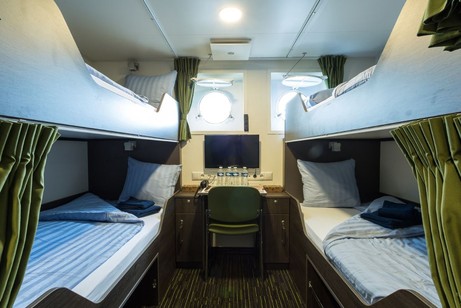
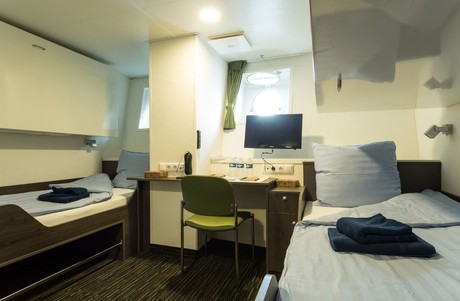
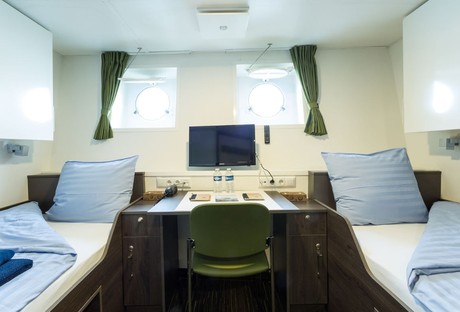
Quadruple Porthole
£4815 GBP pp
Quadruple Porthole
2 portholes 2 upper / lower berths Private shower & toilet Desk & chair Flatscreen TV Telephone & WiFi (supplemented) Hair dryer Ample storage space
Triple Porthole
£6009 GBP pp
Triple Porthole
2 portholes 1 upper / lower berth + 1 single lower berth Private shower & toilet Desk & chair Flatscreen TV Telephone & WiFi (supplemented) Hair dryer Ample storage space
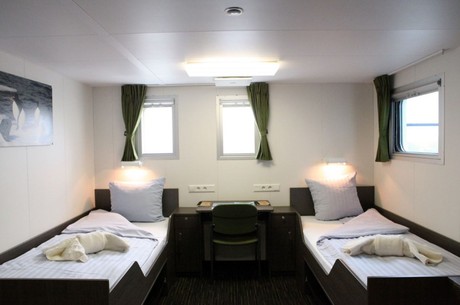
Twin Porthole
£7049 GBP pp
Twin Porthole
2 portholes 2 lower berths Private shower & toilet Desk & chair Flatscreen TV Telephone & WiFi (supplemented) Hair dryer Ample storage space
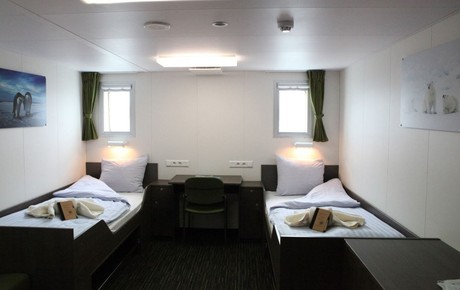
Twin Window
£7625 GBP pp
Twin Window
2 windows 2 lower berths Private shower & toilet Desk & chair Flatscreen TV Telephone & WiFi (supplemented) Hair dryer Ample storage space
Twin Deluxe
£8279 GBP pp
Twin Deluxe
3 windows 2 lower berths Private shower & toilet Desk & chair Small sofa Refrigerator Coffee & tea maker Flatscreen TV Telephone & WiFi (supplemented) Hair dryer Ample storage space
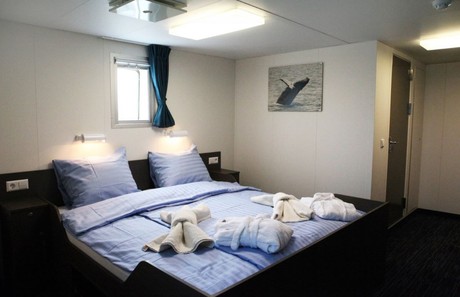
Superior
£9205 GBP pp
Superior
2 windows (minimum) 1 double bed 1 single (sofa) bed Private shower & toilet Desk & chair Flatscreen TV Telephone & WiFi (supplemented) Refrigerator Coffee & tea maker Hair dryer Ample storage space
show reverse itinerary
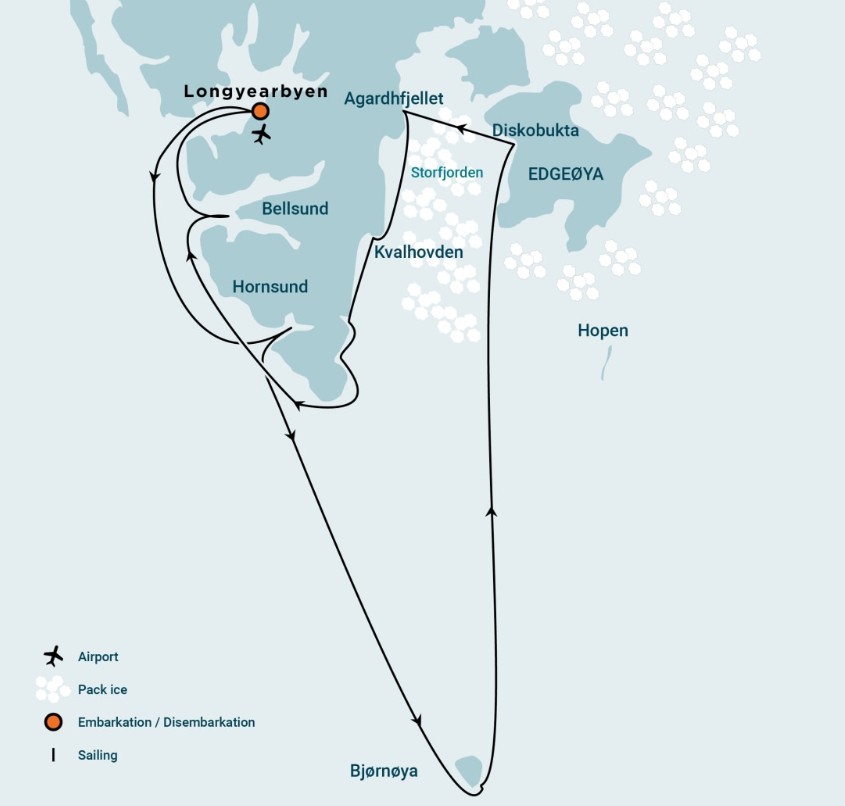
Day 1: Longyearbyen - the start of your journey

You touch down in Longyearbyen, the administrative center of Spitsbergen, the largest island of the Svalbard archipelago. Enjoy strolling around this former mining town, whose parish church and Svalbard Museum make for fascinating attractions. Though the countryside appears stark, more than 100 plant species have been recorded here. In the early evening, the ship sails out of Isfjorden, where you might spot the first minke whale of your voyage.

Day 2: Spectacular Hornsund

We start the day by quietly cruising the side fjords of the spectacular Hornsund area in southern Spitsbergen, dominated by towering mountain peaks. The mountain of Hornsundtind rises to 1,431 meters (4,695 feet), while the peak of Bautaen testifies to why early Dutch explorers gave this island the name Spitsbergen, which translates to “pointed mountains.” There are 14 magnificent glaciers in the area, and we have a fair chance of encountering seals and polar bears. The nearby cliffs of Sofiakammen are also home to thousands of pairs of nesting kittiwakes and little auks. In the evening, we might see thousands of harp seals rutting on ice floes at Sørkapp.

Day 3 - 4: The seabird colonies of Bear Island

Today, we venture along the west side of Bear Island, heading toward the southeast- an excellent place for viewing large seabird colonies. The nearby nesting cliffs are part of an extensive nature reserve where shore landings are not permitted. Afterward, we’ll sail northeast into Sörhamna, where we can get closer to the seabird cliffs. Chiefly, Brünnichs guillemots, kittiwakes, and fulmars nest here.

Just northeast of this is Revdalen, where, at a safe distance, we can watch breeding great skuas, large seabirds known to be fiercely territorial. From there, we may climb some way to the bird mountain at the coast. In Kvalrossbukta, we will land at the remains of a whaling station from the early part of the previous century. As we continue north along the east side of Bear Island, we will look for other good landing and activity spots.

Day 5: Along and through the pack ice

Sailing northward, we may still encounter sea ice, where we have a good chance of spotting polar bears as well as various species of whales, seals, and seabirds. Sailing along the western side of the Tusenøyane, we may see polar bears, walruses, and belugas.

Day 6: Kittiwakes & hiking in Diskobukta canyon

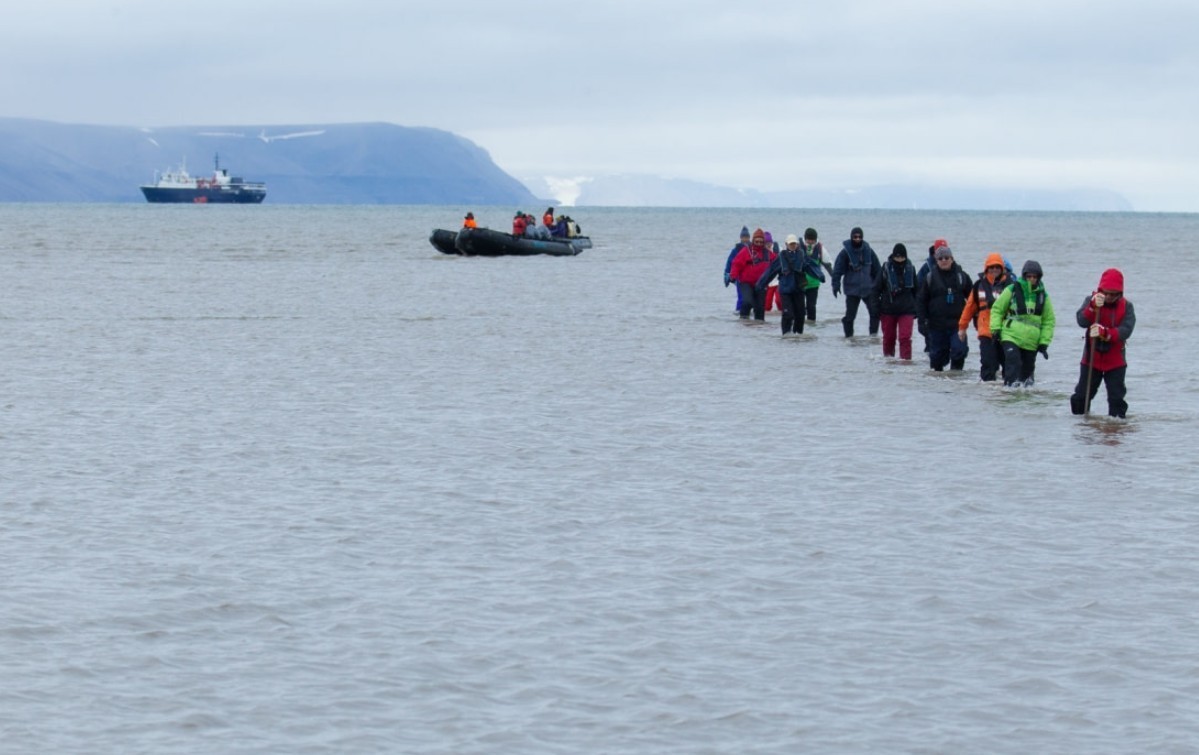
We land at a beach dotted with bones of prehistoric bowhead whales and walk to a canyon with over 10,000 pairs of breeding kittiwakes on both sides, and often Arctic foxes preying on eggs, and sometimes a polar bear. The valley south of the colony is inviting for long walks.

Day 7: The ivory gulls of Agardhfjellet

We land at the east coast of Spitsbergen at the mouth of Skjolddalen river, where ivory gulls gather to breed. Then, a relaxed walk takes us to the summit of Fleinskallen (about 300 m high), with some tens of breeding Ivory Gulls spread along the ridges. Here it pays to keep one eye on the ground at your feet - the area is very rich in fossils, such as belemnites.

Day 8: Dinosaurs and seabird colonies at Kvalhovden

The area around Boltodden is famous for its preserved dinosaur fossil tracks. Behind these are the steep bird mountains of Kvalvaagen, home to many thousands of Brünnich’s Guillemots and other seabirds. At Kvalbreen, we have a good opportunity for a Zodiac cruise and seal observations. Polar bears are not uncommon in this area, so keeping your camera handy here is a must.

Day 9: Bellsund’s flora, fauna, and haunting history

Bellsund is one of the largest fjord systems in Svalbard. Here, there are excellent opportunities to enjoy both history and wildlife. A possibility is Ahlstrandhalvøya, at the mouth of Van Keulenfjorden, where piles of beluga skeletons can be found, remains of poorly managed 19th-century whaling. Thankfully, belugas were not hunted to extinction, and we have a good chance of encountering a pod. Alternatively, while cruising the side fjords of Bellsund, you can explore the tundra where reindeer like to feed, as well as rock slopes where little auks breed, near Vaarsolbukta.

Day 10: There and back again

Even the most remarkable journeys must eventually come to an end. We disembark today in Longyearbyen, taking home memories that will accompany us wherever the next adventure lies. Here, you can further explore the town or prepare for your onward flight.

Please note:

Itineraries are subject to change. 

Ortelius
The ice-strengthened vessel “Ortelius” is an excellent vessel for Polar expedition cruises in the Arctic and Antarctica, providing possibilities to adventure remote locations such as the…

Ortelius

Length 91 metres

The ice-strengthened vessel “Ortelius” is an excellent vessel for Polar expedition cruises in the Arctic and Antarctica, providing possibilities to adventure remote locations such as the Ross Sea.

 The vessel has the highest ice-class notation (UL1 equivalent to 1A) and is therefore very suitable to navigate in solid one-year sea ice and loose multi-year pack ice. “Ortelius” is a great expedition vessel for 100 passengers with lots of open-deck spaces and a very large bridge which is accessible to the passengers. The vessel is manned by 34 highly experienced crew, 15 international catering staff, including stewardesses, 6 expedition staff (1 expedition leader and 5 guides/lecturers) and 1 doctor.

”Ortelius” offers a comfortable hotel standard, with two restaurants, a bar/lecture room and a sauna.   Ortelius' voyages are primarily developed to offer our passengers a quality exploratory wildlife program, trying to spend as much time ashore as possible. As the number of passengers is limited to approximately 100 on the “Ortelius”, flexibility assures maximum wildlife opportunities.

Passengers on a typical voyage range from in their 30s to their 80s, with the majority usually between 45 ― 65. Our expeditions attract independent travelers from around the globe who are characterized by a strong interest in exploring remote regions. The camaraderie that develops on board is an important part of the Oceanwide experience, and many passenger groups include several nationalities.

“Ortelius” was built in Gdynia, Poland in 1989, was named “Marina Svetaeva”, and served as a special purpose vessel for the Russian Academy of Science. The vessel is re-flagged and renamed “Ortelius”. Ortelius was a Dutch / Flemish cartographer. Abraham Ortelius (1527 – 1598) published the first modern world atlas, the Theatrum Orbis Terrarum or Theatre of the World in 1570. At that time, the atlas was the most expensive book ever printed. 

What to Wear
In keeping with the spirit of expedition, dress on board is informal. Bring casual and comfortable clothing for all activities, and keep in mind that much of the scenery can be appreciated from deck ― which can be slippery. Bring sturdy shoes with no-slip soles, and make sure your parka is never far away in case one of our crew shouts “Whales!” over the loudspeaker and you have to dash outside in a moment’s notice. Opt for layers, as it is comfortably warm aboard the ship though often cold on deck.

Electric Current
The electrical supply aboard ship is 220v, 60Hz. Electrical outlets are standard European with two thick round pins, so some passengers may need a 220v/110v converter.

Tipping
The customary gratuity to the ship’s service personnel is made as a blanket contribution at the end of the voyage and is divided among the crew. Tipping is a personal matter, and the amount you wish to give is at your sole discretion. As a generally accepted guideline, we suggest 8 ― 10 euros per passenger per day. It is better for the crew if you give cash.

Smoking Policy
Ortelius has a non-smoking policy inside, though you can smoke in certain designated areas. We ask that you please respect the wishes of non-smokers and please never throw your cigarette ends overboard or anywhere except the designated bin.

Deck plans are for illustrative purposes only – The actual ship and cabin layout may differ.

Cabin layout for Ortelius
Overview
Highlights
Dates & Prices
Itinerary
Map
Ship

10 days from £4815 GBP pp

Find your favorite region