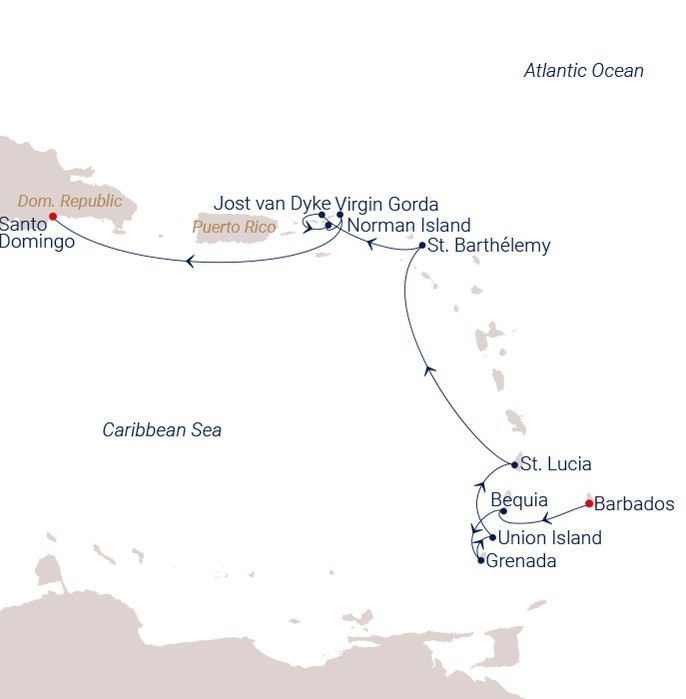
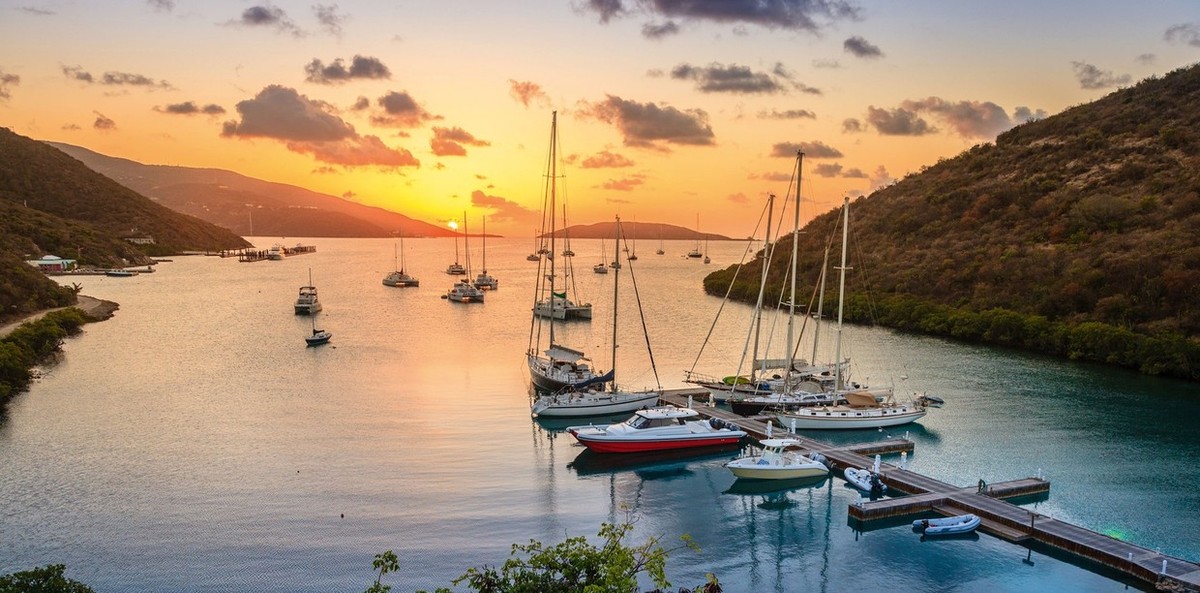
This Caribbean voyage sails from Barbados to the Dominican Republic, weaving through the Grenadines, the Windward Islands, St. Barthélemy, and the British Virgin Islands, with a balance of scenic sea days and time ashore. The route combines colourful island ports with quiet anchorages, from spice-scented Grenada and the dramatic coastline of St. Lucia to the polished harbour of Gustavia and the sheltered bays of Jost van Dyke. Days under sail are paired with opportunities for swimming, snorkelling, and exploring ashore, culminating in a relaxed approach to Santo Domingo after a final day at sea.
Some departures may have slightly modified itineraries. Please confirm the itinerary with an Expedition Specialist.
- Take a Deep Breath: Clove, nutmeg, cinnamon, and ginger grow in abundance on the spice isle of Grenada.
- The Luxury of Leisure Time: Take the zodiac to hidden bays and barefoot barbecues on the beach.
- Celeb-Packed Paradise: St. Barths calls all A-listers with VIP beaches, high-end shopping, and luxe private parties.
- Snorkel, Swim, Paddle: These stops are the most beautiful spots for water sports enthusiasts.
- The Baths: Float in Virgin Gorda’s tidal pools and grottoes, formed from granite boulders on a picturesque beach.
Availability is always subject to confirmation. Please check with us before booking flights
Prices quoted here are often dependent on currency fluctuations. Please check with (01432 507450 or info@small-cruise-ships.com) for the very latest price, which may well be cheaper than the one advertised here.
More than 300 years of British rule have left their mark. The whole of Bridgetown, Barbados' historic center, with its colonial architecture surrounding Trafalgar Square, is a UNESCO World Heritage Site. A green hilly countryside and endless fields of sugar cane characterize the island's landscape. Old colonial houses are reminders of the high life of the plantation owners, while innumerable colorful chattel houses are evidence of their workers' moveable properties. The sweeping coastline is a picture postcard of fine sandy beaches and turquoise sea surrounded by vibrant coral reefs.
Bequia is actually the largest island in the Grenadines, but still small and tranquil at just 87 square miles. Elegant sailing yachts sway in the natural shelter of Admiralty Bay, while in lovely Port Elizabeth, with its attractive beach bars, you are right in the heart of a lifestyle that likes to take things easy. You can find Princess Margaret Beach just nearby, named because it was once visited by the British royal. And on the eastern coast, you can find the Old Hegg Turtle Sanctuary focuses on rearing and caring for endangered turtles.
Beautiful beaches, aromatic spice plantations, dense rainforests, waterfalls, and a volcano that has long been extinct define this stunning island. For many people, Grenada is the incarnation of a tropical paradise and St. George's the most beautiful little port in the Grenadines. All around the horseshoe-shaped bay there are numerous houses reminiscent of colonial times. There is good reason why nutmeg is immortalized on the national flag. Alongside cloves, cinnamon and ginger, it is one of the island's biggest exports.
Right in the south of the Grenadines are Union Island and the Tobago Cays. Union Island was given the evocative name "the Tahiti of the West Indies" thanks to its volcanic silhouette. Four small uninhabited islands, surrounded by a protective horseshoe-shaped coral reef, form the Tobago Cays. The Horseshoe Reef holds the Atlantic swell at bay and its unique animal and plant life make it an ideal place for snorkelling. The lagoon between the islets shimmers in all shades from turquoise through to emerald green and invites you to take a dip at the fantastic beaches.
Two famous volcanic cones are indisputably the emblem of St. Lucia and have been designated as UNESCO World Heritage Sites. Gros and Petit Piton tower over the southern, windward side of the island and, in Soufrière, seem close enough to touch. The volcanoes have in fact long been extinct, but the sulphur springs demonstrate the power of the earth's core and still bubble up. In the Botanical Gardens, natural abundance is combined with artistic arrangements to create a colorful tropical paradise. Some people claim that Josephine, who later became Napoleon's wife, used to bathe in the little pool in the garden.
Few and far between are the occasions, on which one can experience two fascinating windjammers together and directly compare their maneuvers. When both yachts glide along side by side under full sail, they offer a truly breathtaking spectacle.
St. Barthélemy, affectionately known as St. Barths by most, already had many "owners" before the Lesser Antilles were acquired by France in 1877. When the first estate was acquired by the banker David Rockefeller in 1957, the island's future was finally sealed. It became a refuge for the international jet set and an elegant holiday paradise for many Hollywood stars. For over 40 years, St. Barths has cultivated a luxurious lifestyle with a Caribbean laissez-faire approach. You can stroll through the charming main town of Gustavia, whose beautifully restored houses and colonial facades look out over the sea with its elegant superyachts, browse in the shops for precious items, or enjoy a sundowner in the picturesque harbor surrounded by clusters of high class bars and restaurants.
The Sir Francis Drake Channel, where swords once crossed, is now one of the most beautiful sailing spots. Jost van Dyke, the smallest of the main islands in the British Virgin Islands, is a mountainous volcanic object of beauty with fewer than 300 inhabitants. One of them, Foxy, has been mixing his cocktails since 1968 and the bar of the same name enjoys a legendary reputation as perhaps the most famous beach bar in the Lesser Antilles. The island's past is less reputable – it was named by a Dutch pirate. The island gives its most beautiful treasures to all who visit – fine sand, green palm trees, colorful beach bars and the luminous blue of the sea.
The Sir Francis Drake Channel, where swords were once crossed, is now one of the most beautiful sailing spots. Jost van Dyke, the smallest of the main islands in the British Virgin Islands, is a mountainous volcanic object of beauty with fewer than 300 inhabitants. One of them, Foxy, has been mixing his cocktails since 1968 and the bar of the same name enjoys a legendary reputation as perhaps the most famous beach bar in the Lesser Antilles. The island's past is less reputable – it was named by a Dutch pirate. The island gives its most beautiful treasures to all who visit – fine sand, green palm trees, colorful beach bars and the luminous blue of the sea.
It almost seems as if no other career choice than pirate was possible in the 17th and 18th centuries in the British Virgin Islands. Jost van Dyke, Blackbeard, Francis Drake – they all went on the prowl in the Dream Territory during the golden age of privateering. Norman Island was named after the pirate captain Norman, who allegedly hid his treasures here, and inspired Robert Louis Stevenson to write his adventure novel “Treasure Island”. If you dig a little in the fine sand on the uninhabited private island today, you probably won’t discover any gold coins, but you will discover an equally valuable treasure: deep, Caribbean relaxation.
Explorers once used to cross swords in the Sir Francis Drake Channel. Nowadays the sea around the British Virgin Islands is one of the world's best sailing areas. Heavenly bays, gorgeous beaches, idyllic anchoring spots, smart yacht clubs and charming little beach bars make the island a popular haunt for sailors. On Virgin Gorda, once called "The Fat Virgin" by Columbus due to its shape, you can find "The Baths", one of nature's most beautiful oddities, in the National Park. Ground to a sphere and polished to a shine, the huge granite formations on the beach and in the water create a multi-branched labyrinth of giant boulders.
Spend the day sunbathing, enjoy the fresh wind breeze, and relax into the day!
On this island, which is part of Hispaniola, Columbus founded the first Spanish colony in America. Santo Domingo, the present capital of the Dominican Republic, is the first and oldest European-founded city in the New World. Old in the New World still means relatively young – it corresponds to Renaissance visions of the ideal and was the model for many cities in Latin America. A visit to the historic old city is like a journey through time. The splendid stone buildings are testament to the era of the colonial conquests and have been smartened up as World Heritage Sites under the protection of UNESCO.
Itineraries are subject to change.
Sea Cloud II
Vessel Type: Tall Ship (Sailing)
Length: 105 metres
Passenger Capacity: 96
Built: 2001
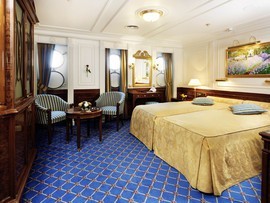
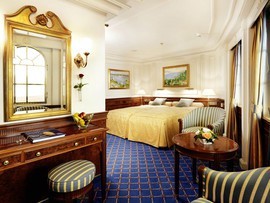
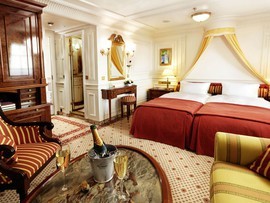
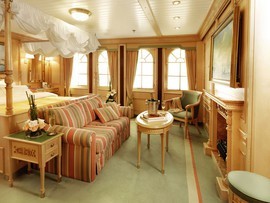
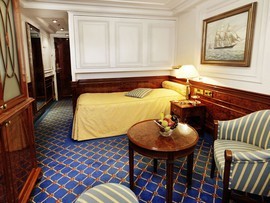
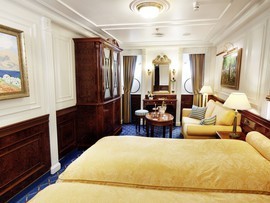
Launched in 2001, Sea Cloud II is a stunning vessel, built along traditional lines, but offering deluxe accommodation. She combines timeless elegance of sailing ships of the past with the highest safety standards and the luxurious comfort of modern cruise ships. Just like her legendary sister ship Sea Cloud, the 29,600 square feet of sails is set by hand which is a truly magical sight. Built to accommodate 96 passengers in five star luxury, she offers a range of beautifully appointed suites and cabins which are furnished with great style. All accommodations have outside views and the bathrooms, in light marble, are unusually spacious and extremely comfortable. The finest, carefully chosen fabrics, combined with leather, rattan and other materials, brass and gold, precious woods and marble together create an impressive ensemble.
No expense has been spared to create a sympathetic ambience in both the accommodations and public areas and this is reflected throughout the vessel. Public areas include an elegant lounge, library, fitness centre, boutique, lido bar and hospital. The single sitting dining room is airy and modern and the quality of the cuisine and service will be to the highest of standards, as one would expect on a Sea Cloud cruise. Relax on the Lido deck and experience the natural grandeur of travelling under sail, rekindling memories of a bygone age.
Deck plans are for illustrative purposes only – The actual ship and cabin layout may differ.