Deep South Basecamp Experience

Find the perfect trip

14 days from

£8875 GBP pp

* Current p/p indicative rate.

Overview
Highlights
Dates & Prices
Itinerary
Map
Ships

Highlights

  • Camping - FREE - Special gear and field equipment will be provided. Camping is subject to weather, local site and environmental regulations.
  • Snow-Shoeing - FREE - Snowshoe walking is easy and does not require any technical skills. The snowshoes will fit all boot sizes and can be used in combination with Oceanwide’s rubber boots
  • Photo Workshop - FREE - Participants with a special interest in photography will bring their personal photo equipment. The workshop must be pre-booked prior to departure.
  • Kayaking - FREE - Basic kayaking experience is of advantage, but it is not a requirement. Physical fitness is essential. Kayaking is subject to weather and prevailing ice conditions.
  • Long Hikes (Antarctica) - FREE - These walks offer an immersive experience in the pristine polar landscape, requiring participants to be prepared for up to six hours of hiking on semi-rough, rocky and snowy terrain with notable elevation changes.

Highlights

  • Camping - FREE - Special gear and field equipment will be provided. Camping is subject to weather, local site and environmental regulations.
  • Snow-Shoeing - FREE - Snowshoe walking is easy and does not require any technical skills. The snowshoes will fit all boot sizes and can be used in combination with Oceanwide’s rubber boots
  • Photo Workshop - FREE - Participants with a special interest in photography will bring their personal photo equipment. The workshop must be pre-booked prior to departure.
  • Kayaking - FREE - Basic kayaking experience is of advantage, but it is not a requirement. Physical fitness is essential. Kayaking is subject to weather and prevailing ice conditions.
  • Long Hikes (Antarctica) - FREE - These walks offer an immersive experience in the pristine polar landscape, requiring participants to be prepared for up to six hours of hiking on semi-rough, rocky and snowy terrain with notable elevation changes.
Capacity: 106, Types: ExpeditionResearch
Feture image for Deep South Basecamp Experience

The Deep South Basecamp experience offers you a myriad of ways to explore and enjoy the Antarctic region. This expedition allows you to (long) hike, snowshoe, kayak, and even camp out under the Southern Polar skies.

  • Camping - FREE - Special gear and field equipment will be provided. Camping is subject to weather, local site and environmental regulations.
  • Snow-Shoeing - FREE - Snowshoe walking is easy and does not require any technical skills. The snowshoes will fit all boot sizes and can be used in combination with Oceanwide’s rubber boots
  • Photo Workshop - FREE - Participants with a special interest in photography will bring their personal photo equipment. The workshop must be pre-booked prior to departure.
  • Kayaking - FREE - Basic kayaking experience is of advantage, but it is not a requirement. Physical fitness is essential. Kayaking is subject to weather and prevailing ice conditions.
  • Long Hikes (Antarctica) - FREE - These walks offer an immersive experience in the pristine polar landscape, requiring participants to be prepared for up to six hours of hiking on semi-rough, rocky and snowy terrain with notable elevation changes.

Availability is always subject to confirmation. Please check with us before booking flights

04 March, 2026 to 17 March, 2026 on Ortelius
Prices

Prices quoted here are often dependent on currency fluctuations. Please check with (01432 507450 or info@small-cruise-ships.com) for the very latest price, which may well be cheaper than the one advertised here.
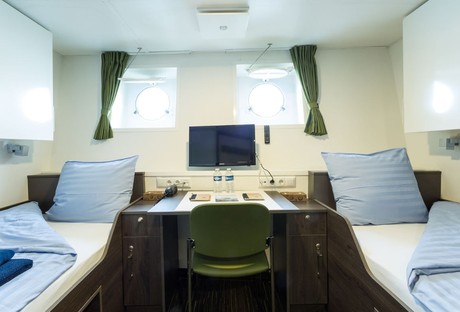
Quadruple Porthole
£8875 GBP pp
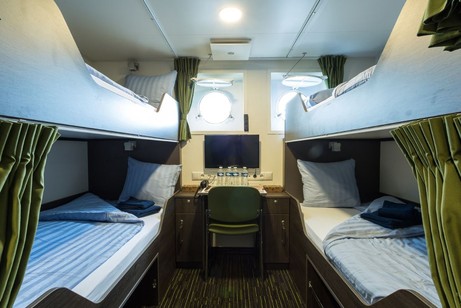
Quadruple Porthole
2 portholes 2 upper / lower berths Private shower & toilet Desk & chair Flatscreen TV Telephone & WiFi (supplemented) Hair dryer Ample storage space
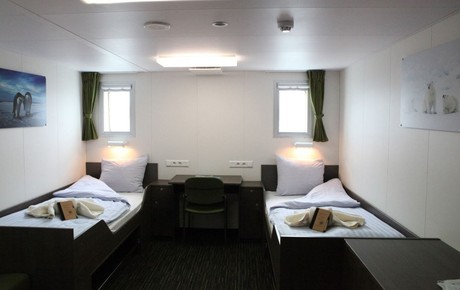
Twin Porthole
£10875 GBP pp
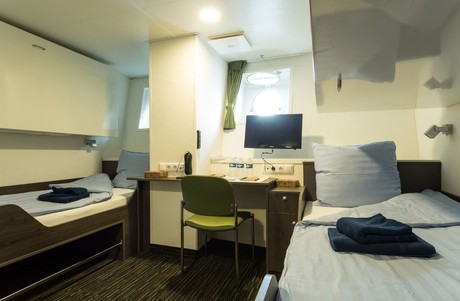
Twin Porthole
2 portholes 2 lower berths Private shower & toilet Desk & chair Flatscreen TV Telephone & WiFi (supplemented) Hair dryer Ample storage space
Triple Porthole
£10875 GBP pp
Triple Porthole
2 portholes 1 upper / lower berth + 1 single lower berth Private shower & toilet Desk & chair Flatscreen TV Telephone & WiFi (supplemented) Hair dryer Ample storage space
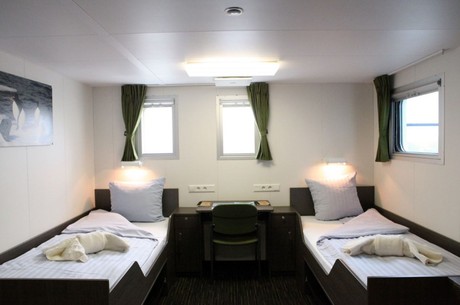
Twin Window
£11355 GBP pp
Twin Window
2 windows 2 lower berths Private shower & toilet Desk & chair Flatscreen TV Telephone & WiFi (supplemented) Hair dryer Ample storage space
Twin Deluxe
£12315 GBP pp
Twin Deluxe
3 windows 2 lower berths Private shower & toilet Desk & chair Small sofa Refrigerator Coffee & tea maker Flatscreen TV Telephone & WiFi (supplemented) Hair dryer Ample storage space
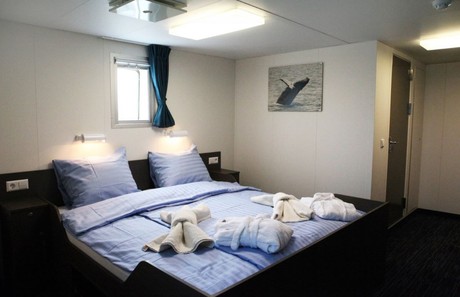
Superior
£13185 GBP pp
Superior
2 windows (minimum) 1 double bed 1 single (sofa) bed Private shower & toilet Desk & chair Flatscreen TV Telephone & WiFi (supplemented) Refrigerator Coffee & tea maker Hair dryer Ample storage space
show reverse itinerary
Day 1 - End of the world, start of a journey

Your voyage begins where the world drops off. Ushuaia, Argentina, reputed to be the southernmost city on the planet, is located on the far southern tip of South America. Starting in the afternoon, you embark from this small resort town on Tierra del Fuego, nicknamed “The End of the World,” and sail the mountain-fringed Beagle Channel for the remainder of the evening.

Days 2 to 3 - Path of the polar explorers

Over the next two days on the Drake Passage, you enjoy some of the same experiences encountered by the great polar explorers who first charted these regions: cool salt breezes, rolling seas, maybe even a fin whale spouting up sea spray. After passing the Antarctic Convergence – Antarctica’s natural boundary, formed when north-flowing cold waters collide with warmer sub-Antarctic seas – you are in the circum-Antarctic upwelling zone.

Not only does the marine life change, the avian life changes too. Wandering albatrosses, grey-headed albatrosses, black-browed albatrosses, light-mantled sooty albatrosses, cape pigeons, southern fulmars, Wilson’s storm petrels, blue petrels, and Antarctic petrels are a few of the birds you might see.

Day 4 - Through the Pendleton Strait

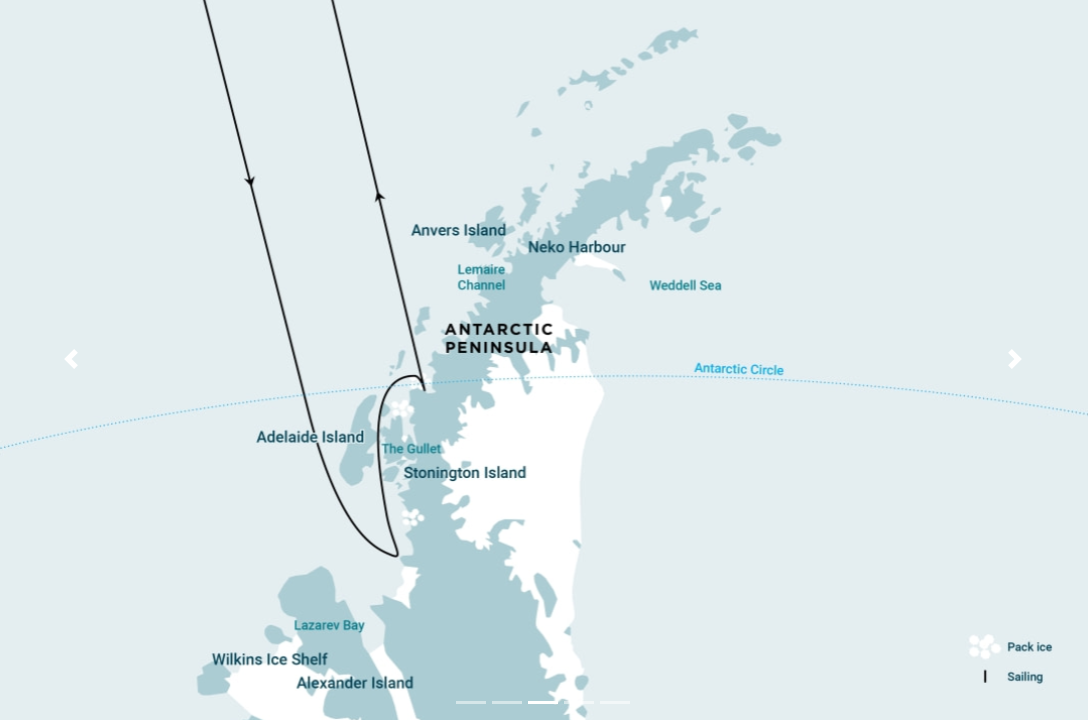
Arriving at the Antarctic Peninsula near the Antarctic Circle. If sea ice conditions permit, you may continue through Pendleton Strait and attempt a landing at the rarely visited southern tip of Renaud Island. Here, you have the opportunity to encounter the first Adélie penguins of the voyage and enjoy spectacular views of icebergs in this surreal, snow-swept environment.

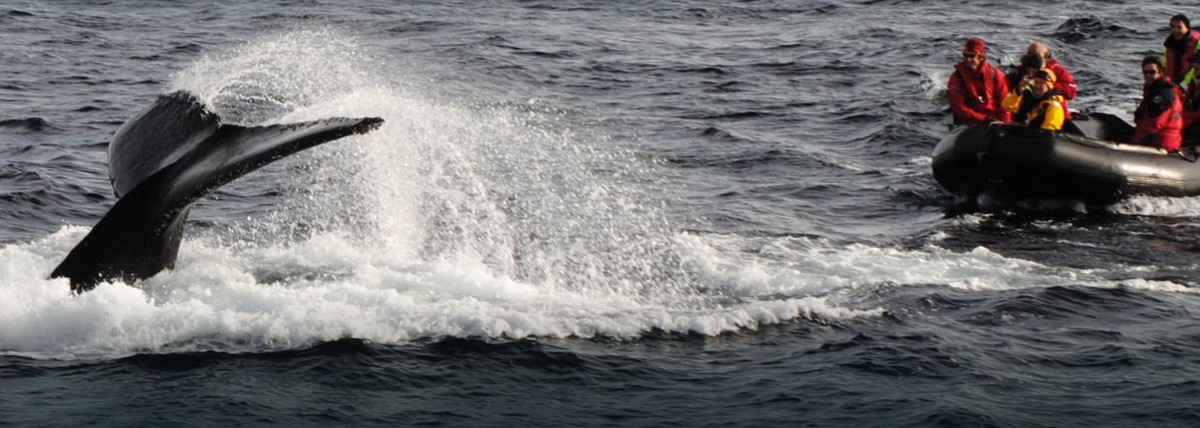
Later in the afternoon, we will continue our journey towards Adelaide Island and Marguerite Bay, crossing the Polar Circle. We will spend the night in the area of Crystal Sound, where the scenery is so captivating it may keep you awake into the early hours. This region also offers the chance to spot orcas, humpback whales, and minke whales.

Days 5 to 8 - Marguerite Bay as a setting for activities

Over the coming days, we have the opportunity to experience a variety of planned activities in this incredible setting, deep in Antarctica.

Places you might visit include:

Horseshoe Island - Horseshoe Island is named for its distinctive shape. An abandoned research station here offers insight into the early days of scientific exploration, with original artifacts illustrating the stark contrast between life then and now. The hut is set amidst some of the most breathtaking scenery in Antarctica, offering views over the mountains and snow of Pourquoi Pas Island, as well as Horseshoe Island’s own rugged peaks. This is a photographic landing in every sense. Two old wooden boats still rest at the site, as if awaiting one final launch.

Pourquoi Pas Island - Discovered and charted by the renowned explorer Jean-Baptiste Charcot, Pourquoi Pas Island offers a scenic landing on a rocky beach set against the backdrop of the impressive Moider Glacier. A gentle walk from the landing site reveals stunning vistas, while Antarctic fur seals lounging just beyond the beach add a delightful wildlife encounter to our journey.

Stonington Island - A site of major research activity from the 1930s to the 1970s, Stonington Island hosted both American and British bases. It features a variety of historic buildings and artifacts that tell the story of early Antarctic exploration. Once connected to the mainland by snow and ice, this evocative site now stands as a poignant reminder of Antarctica’s isolation and the fragile interplay between human history and raw wilderness. The blend of wildlife, natural grandeur, and preserved structures makes this an unforgettable stop, sure to leave a lasting impression.

Red Rock Ridge - Located on the Antarctic mainland, Red Rock Ridge is distinguished by its vivid red-hued cliffs, which stand out sharply against the icy surroundings and are visible from afar. If conditions allow, we will attempt a landing here. We might encounter Adélie penguins and we also hope to spot seals and Antarctic shags that nest nearby.

Days 9 to 10 - The Gullet and Detaille Island

If conditions allow, we then sail through The Gullet, one of the most impressive narrow channels in Antarctic, with towering mountains either side, birds following the ship and playful penguins and seals frolicking in the water as we sail through this very special part of the journey. If ice conditions allow we will also carry out a landing or cruise in the afternoon.

We may make a landing at an abandoned British research station here, taking in the island’s lofty position and imposing glaciers scenery.

Days 11 to 13 - Familiar seas, familiar friends

Your return voyage is far from lonely. While crossing the Drake, you’re again greeted by the vast array of seabirds remembered from the passage south. But they seem a little more familiar to you now, and you to them.

Day 14 - There and back again

Every adventure, no matter how grand, must eventually come to an end. It’s now time to disembark in Ushuaia, but with memories that will accompany you wherever your next adventure lies.

Please note:

Itineraries are subject to change. 

Ortelius
The ice-strengthened vessel “Ortelius” is an excellent vessel for Polar expedition cruises in the Arctic and Antarctica, providing possibilities to adventure remote locations such as the…

Ortelius

Length 91 metres

The ice-strengthened vessel “Ortelius” is an excellent vessel for Polar expedition cruises in the Arctic and Antarctica, providing possibilities to adventure remote locations such as the Ross Sea.

 The vessel has the highest ice-class notation (UL1 equivalent to 1A) and is therefore very suitable to navigate in solid one-year sea ice and loose multi-year pack ice. “Ortelius” is a great expedition vessel for 100 passengers with lots of open-deck spaces and a very large bridge which is accessible to the passengers. The vessel is manned by 34 highly experienced crew, 15 international catering staff, including stewardesses, 6 expedition staff (1 expedition leader and 5 guides/lecturers) and 1 doctor.

”Ortelius” offers a comfortable hotel standard, with two restaurants, a bar/lecture room and a sauna.   Ortelius' voyages are primarily developed to offer our passengers a quality exploratory wildlife program, trying to spend as much time ashore as possible. As the number of passengers is limited to approximately 100 on the “Ortelius”, flexibility assures maximum wildlife opportunities.

Passengers on a typical voyage range from in their 30s to their 80s, with the majority usually between 45 ― 65. Our expeditions attract independent travelers from around the globe who are characterized by a strong interest in exploring remote regions. The camaraderie that develops on board is an important part of the Oceanwide experience, and many passenger groups include several nationalities.

“Ortelius” was built in Gdynia, Poland in 1989, was named “Marina Svetaeva”, and served as a special purpose vessel for the Russian Academy of Science. The vessel is re-flagged and renamed “Ortelius”. Ortelius was a Dutch / Flemish cartographer. Abraham Ortelius (1527 – 1598) published the first modern world atlas, the Theatrum Orbis Terrarum or Theatre of the World in 1570. At that time, the atlas was the most expensive book ever printed. 

What to Wear
In keeping with the spirit of expedition, dress on board is informal. Bring casual and comfortable clothing for all activities, and keep in mind that much of the scenery can be appreciated from deck ― which can be slippery. Bring sturdy shoes with no-slip soles, and make sure your parka is never far away in case one of our crew shouts “Whales!” over the loudspeaker and you have to dash outside in a moment’s notice. Opt for layers, as it is comfortably warm aboard the ship though often cold on deck.

Electric Current
The electrical supply aboard ship is 220v, 60Hz. Electrical outlets are standard European with two thick round pins, so some passengers may need a 220v/110v converter.

Tipping
The customary gratuity to the ship’s service personnel is made as a blanket contribution at the end of the voyage and is divided among the crew. Tipping is a personal matter, and the amount you wish to give is at your sole discretion. As a generally accepted guideline, we suggest 8 ― 10 euros per passenger per day. It is better for the crew if you give cash.

Smoking Policy
Ortelius has a non-smoking policy inside, though you can smoke in certain designated areas. We ask that you please respect the wishes of non-smokers and please never throw your cigarette ends overboard or anywhere except the designated bin.

Deck plans are for illustrative purposes only – The actual ship and cabin layout may differ.

Cabin layout for Ortelius
Overview
Highlights
Dates & Prices
Itinerary
Map
Ship

14 days from £8875 GBP pp

Trip Tags
Wildlife Cruises
Find your favorite region