
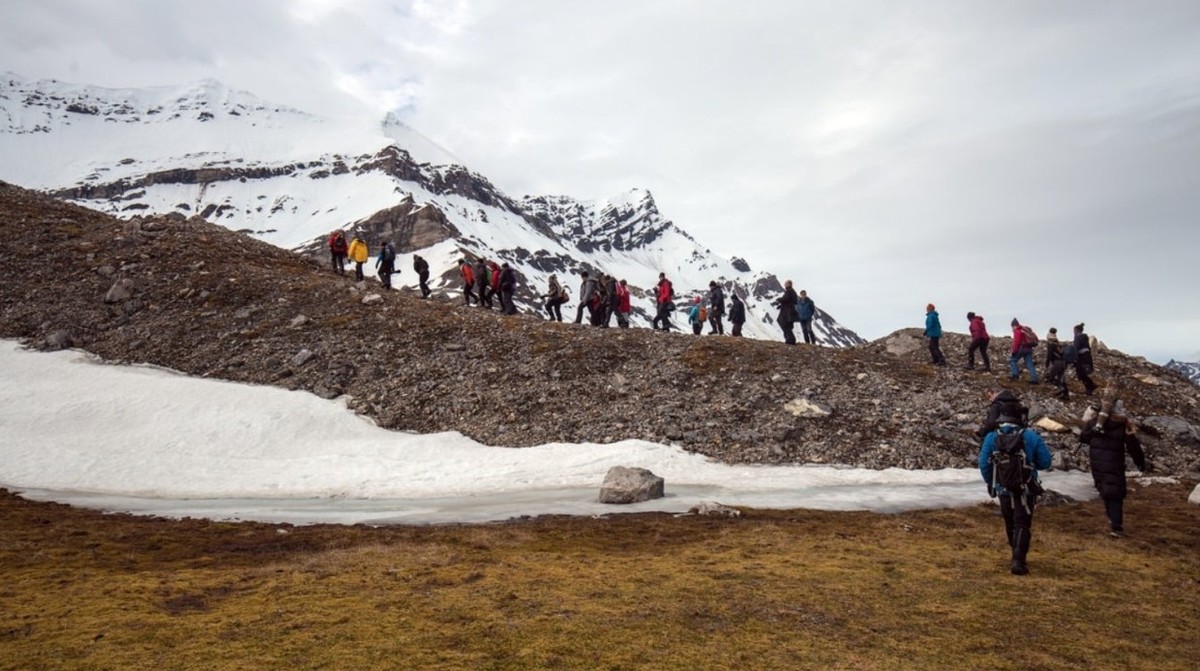
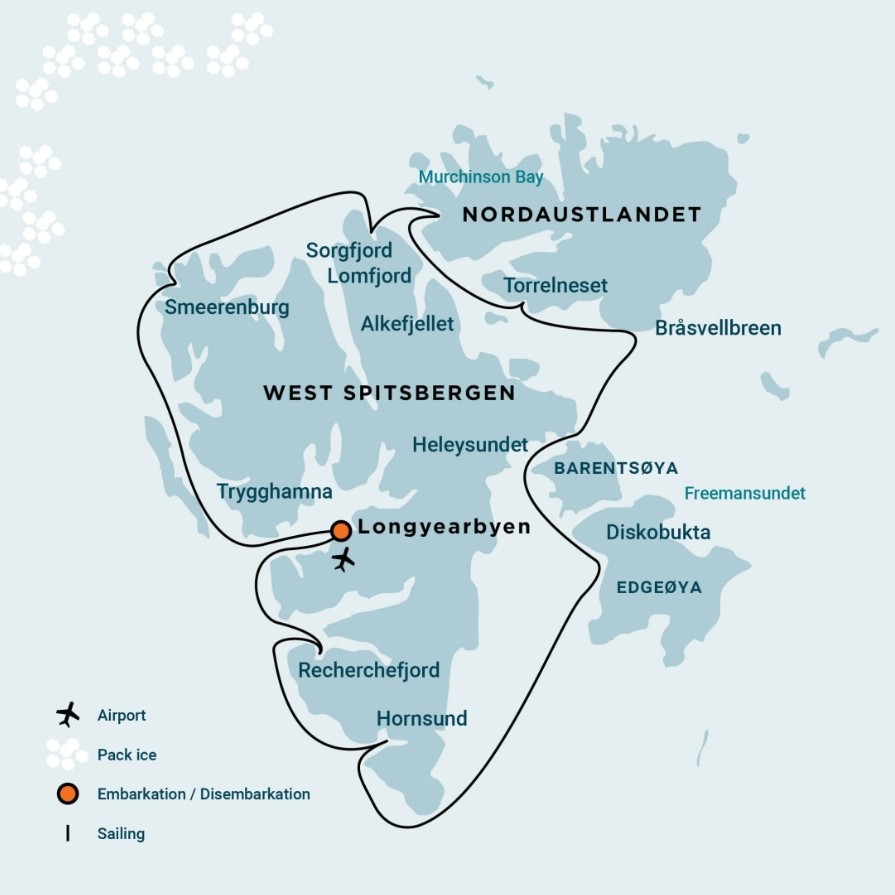
Sail around Spitsbergen taking in the wildlife, whaling history, and stunning landscapes. Visit historic whaling stations and search for walruses and reindeer. Head to Hornsund to explore the glaciers and the hunting grounds of the Polar Bear.
- Isfjord - The second longest fjord in Svalbard, Isfjord lies on the west side of the principal island of Spitsbergen
- Bellsund - A beautiful sound in the Arctic archipelago of Svalbard
- Hornsund - Part of the South Spitsbergen National Park, the Hornsund is a fjord found on the west side of Spitsbergen, on the southern tip of the island.
- Shore-Based Walking - Explore the last true wilderness of our planet on foot, and absorb the beauty of the polar regions at your own pace
- Zodiac Cruising & Shore Program - By Zodiac you will explore the polar world, getting up close to icebergs, glaciers, and iconic wildlife
- Walrus - Spending two thirds of their lives in the water, these "tooth-walking sea horses" cuddle their calves in the same fashion as human mothers
Availability is always subject to confirmation. Please check with us before booking flights
Prices quoted here are often dependent on currency fluctuations. Please check with (01432 507450 or info@small-cruise-ships.com) for the very latest price, which may well be cheaper than the one advertised here.

Rembrandt van Rijn
| Length | 56 metres |
|---|---|
| speed | 9 knots |
| Cabins | 16 |
S/V ‘Rembrandt Van Rijn’ was originally built as a herring lugger. The vessel was rebuilt as a three-masted passenger sailing schooner in The Netherlands in 1994 and sailed in Spitsbergen (1994 – 1996) and in Galápagos (1998 - 2001). The vessel underwent a complete rebuilding and refurbishment program in 2011. The communication and navigation equipment has been completely renewed according to the latest SOLAS regulations.
The Rembrandt van Rijn measures 56 meters in length (168 ft.), 7 meters in width and has a draft of 2, 5 meters.
•The maximum engine speed is 9 knots
•She has an experienced crew of 12 on board including two tour guides
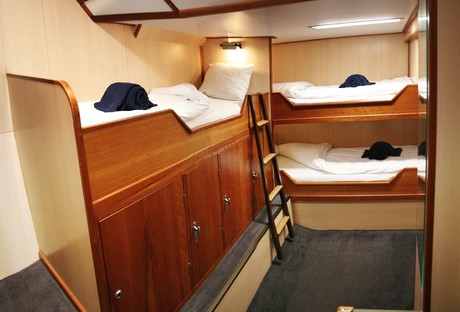
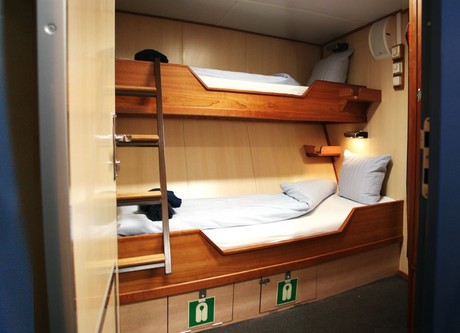
•The ship can accommodate a maximum of 33 passengers in 16 cabins
•1 Triple Private cabin with porthole (with shower and toilet)
•6 Twin Private Inside cabins (with shower and toilet, no porthole)
•9 Twin Private cabins (with shower and toilet and porthole)
•The general interior public areas include a spacious restaurant area so that all meals can be taken together as well as separate bar area and reading table area
•There is room to relax, read and socialize
•The ship is well suited for expedition cruising among small islands and offers excellent open deck viewing areas, even when under sail. The two inflatable rubber crafts (zodiacs) enable landing and wildlife viewing opportunities in otherwise inaccessible areas.

_kees_beekman.jpg)


_monica_salmang-oceanwide_expeditions.jpg)
Deck plans are for illustrative purposes only – The actual ship and cabin layout may differ.

Includes
- Voyage aboard the indicated vessel as indicated in the itinerary.
- All meals throughout the voyage aboard the ship including snacks, coffee and tea.
- All shore excursions and activities throughout the voyage by Zodiac.
- Program of lectures by noted naturalists and leadership by experienced expedition staff.
- Free use of rubber boots and snowshoes on Plancius, Ortelius, Hondius and Janssonius.
- Free use snowshoes on Rembrandt van Rijn.
- On Spitsbergen voyages: Transfers and baggage handling between the airport, hotels and ship only for those passengers on the group flights to and from Longyearbyen.
- On Rembrandt voyages: Transfers and baggage handling between airport and ship at Constable Pynt on the chartered group flights.
- Luggage transfer from pick-up point to the vessel on the day of embarkation, in Ushuaia.
- Pre-scheduled group transfer from the vessel to the airport in Ushuaia (directly after disembarkation).
- All miscellaneous service taxes and port charges throughout the program.
- AECO fees and governmental taxes.
- Comprehensive pre-departure material.