
Contact us
* Current p/p indicative rate.
Highlights
- Rurutu, Austral Islands
- Rimatara, Austral Islands
- Rapa, Austral Islands
- Raivavae, Austral Islands
Highlights
- Rurutu, Austral Islands
- Rimatara, Austral Islands
- Rapa, Austral Islands
- Raivavae, Austral Islands


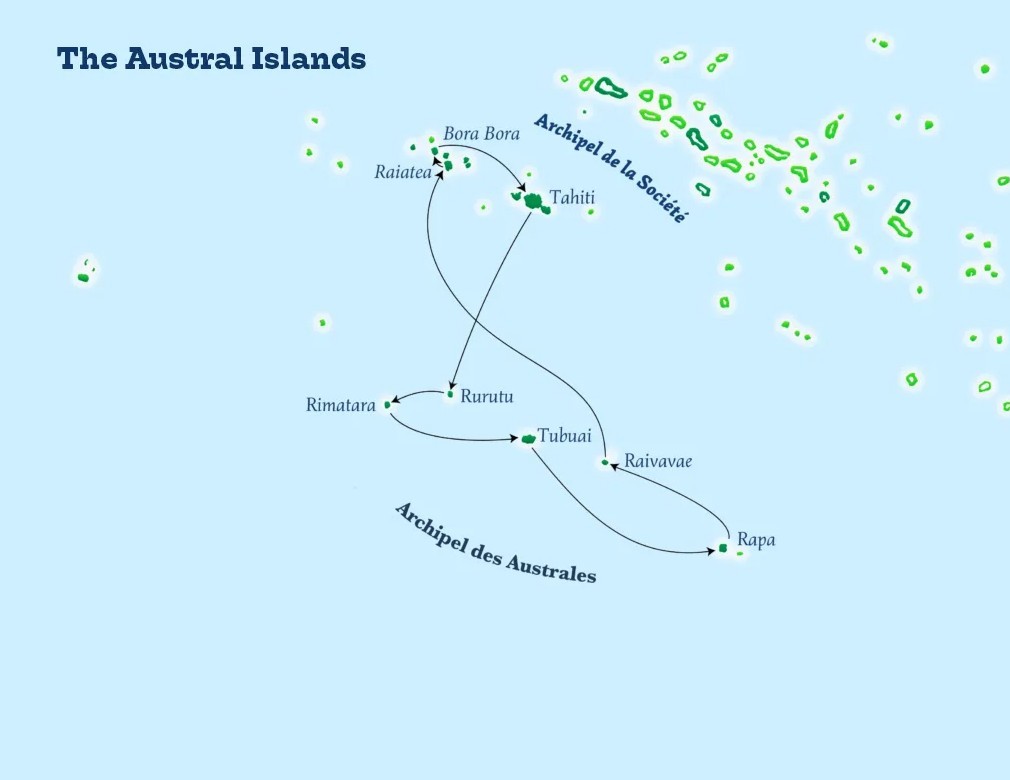
Discovered by Europeans in the 18th Century, the Australs are located 373 miles (600 km) south of Tahiti’s capital city. The archipelago is made of seven islands, five of which are inhabited – Rimatara, Rurutu, Tubuai, Raivavae and Rapa – and four of which are accessible by air. 6,800 people live in the Austral islands, an off the beaten track archipelago of untouched and mysterious land where white sand clashes with the intense blue of the lagoons.
Breath-taking landscapes, from sheer mountains to valleys and high plains, these islands are famous for their farming activities. Several archaeological remains witness to a well organised, pre-European community of rich cultural and religious practices. The cliffs and caves of the Austral Islands were ancient burial grounds and now provide a platform from which visitors can watch Humpback Whales frolic in the water just offshore as they come here from August to October to give birth.
Passengers will take a guided tour of the island’s colourful, picturesque villages and discover the handiwork of islanders who mainly live off their artwork. During their Polynesian cruise they will also enjoy watching fishermen, farmers and basket weavers at work and are unlikely to leave without purchasing a hat or a woven basket to remind them of their magical time in the Austral Islands.
Not all departures visit Rapa Island. Please check individual departures for more information.
- Rurutu, Austral Islands
- Rimatara, Austral Islands
- Rapa, Austral Islands
- Raivavae, Austral Islands
Availability is always subject to confirmation. Please check with us before booking flights
There are no future departures for this trip at this stage.
You will embark on the Aranui 5 between 7:00 and 9:00 am in the morning. Departure around 12:00 pm. You will be warmly welcomed by our Polynesian crew and begin the big journey to the Austral Islands.
Rurutu, one of the two largest raised atolls in French Polynesia, is unique because of its geological structure which is surprising as one does not expect to discover such landscapes in the South Pacific. Basalt and limestone cliffs dotted with caves where islanders once lived, a volcanic interior with lush tropical jungle, white sand beaches and beautiful bays offer breathtaking views. Rurutu is known throughout Polynesia for the exceptional quality of its basketry, such as beautiful hats, bags and baskets or rugs made of pandanus leaves and other natural materials. The Aranui at anchor, off Rurutu, passengers will disembark, after lunch on board, by tender on the “Moerai”
On the second day, a flower welcome accompanied by Polynesian songs and rhythms on their “ukulele”, guitars and drums will captivate you. Board the trucks, it’s time to visit the wonders of the island. Basalt and limestone cliffs dotted with caves where islanders once lived, lush tropical jungle, white sand beaches and beautiful bays offer breathtaking views. The island’s fertile soil and cooler climate are suitable for growing coffee and taro. A traditional and typical Rurutu meal will be served at the mayor’s house with the opening of the “umu’ai”. Enjoy the white sandy beach of Vitaria and its lagoon. Every year, from August to September, humpback whales can be seen and heard in Rurutu where they come to mate and give birth. The Aranui 5 being there in September, it should be a delight for your eyes and ears. This activity is offered as an option with the visit of the Mole’e cave, nicknamed “the mouth of the monster” for experienced hikers (registration at the reception).
The Aranui disembarks at the “Taanini” dock. A small circular volcanic plateau, Rimatara, the last island of the archipelago to be discovered in the 19th century by Captain Samuel Pinder Henry, has preserved its old traditions, including its own dialect. It is home to an endemic bird, the amazing and colorful Kuhl’s Lori, the “Ura”, which is also found in the Cook Islands.After passing through a purification smoke ceremony, an ancient tradition of welcome, discover the main villages, Amaru, Anapoto and Motuaura by mini-bus or truck. In the old cemetery of Amaru, facing the sea, lies the entire lineage of kings and queens who ruled the island of Rimatara. An old legend says that you should never make faces in front of the royal tomb, otherwise you will remain disfigured for the rest of your life. A barbecue will be served on the beach of Motuaura. Its crystal-clear waters invite you to dive in and discover it with a mask and snorkel. Covered with taro plants and fruit trees, Rimatara is a flower garden with a fresh water well. A bird watching excursion to discover the red parakeet “Ura” is offered as an optional activity (sign-up at the reception).
Tubuai is the most populated island of the Austral Islands. Arriving by tender at the landing stage of Bloody Bay, passengers are welcomed at the town hall with a wreath of flowers, to the sound of local music. You will be able to attend art and craft demonstrations of pandanus leaf weaving and shell necklace making, specific to the island. The island’s fertile soil and cooler climate are ideal for growing cabbage, lettuce, and potatoes. Among the day’s activities: the visit of the cultural sites of the island by truck, the marae of “PO TUI TUI”, Fort George, the first refuge of the mutineers of the Bounty from July to September 1789 and Bloody Bay, witness to the fighting between the islanders and the mutineers. Lunch will be served on board. The beach of Bloody Bay invites you to dive in and discover it with a mask and snorkel.
A day to relax on the Pool Deck or in the comfort of our air-conditioned Lounge. Or why not simply enjoy the views of the South Pacific Ocean during our crossing to Rimatara. Lectures on the culture and history of the Austral Islands will give you a complete overview of this civilization. During the cruise, the spirited Polynesian crew will proudly introduce you to their way of life and entertain you with Polynesian songs and rhythms on their “ukulele”, guitars and drums.
As you approach Rapa, only accessible by sea, the Captain may announce: “Welcome to Rapa. Next stop Antarctica”. As the southernmost inhabited island of French Polynesia, this crescent shaped land mass — with a fjord-like coastline deeply indented by 12 bays —is as remote as it gets. Rapa is Easter Island’s little sister. It has a temperate climate, no coral or coconut trees, but fruits and vegetables other than tropical ones are plentiful here: apples, peaches, nectarines… The Aranui will disembark at the dock in Ahurei. Passengers will be greeted with flower wreaths, to the typical sounds and rhythms of Rapa. Trucks will be waiting for you, heading to the cultural center. You will discover how the “mamas” make local crafts: hats and baskets made of reed (a fragile material) and bamboo crafts. A local meal will be served on land. On Rapa, we propose a two and a half hour walk to Fort Morango Uta. Polynesian evening with a plancha buffet around the pool (Deck 7) or in the Restaurant (Deck 4) depending on the weather conditions.
Among the other activities on offer during our one and a half day stopover in Rapa, you will visit Ahurei, the main village of the island, explore ancient fortresses, visit an agricultural production centre, discover local arts and crafts, meet the inhabitants of this isolated island, and share a ma’a over a wood fire in the village.
It is said that Raivavae is the “Bora Bora of yesteryear” and that its lagoon is the most beautiful in Tahiti & her islands. A jewel preserved by its inhabitants; the island is a veritable garden of Eden where visitors fall under
her spell. When the Aranui is at anchor, passengers disembark by tender onto Mahanatoa beach where they will be welcomed with wreaths of flowers, to the sound of Raivavae songs and rhythms. Departure by bus for a tour of the island. Do not miss the visit of the “Smiling Tiki” and the marae scattered around the island. Of course, its inhabitants will serve you a typical Raivavae
buffet on Mahanatoa beach. Take advantage of the remaining time to walk around the village or to discover its lush lagoon with a mask and snorkel. The discovery of Mount Hiro will be offered as an option (sign-up at the reception).
A day to relax on the Pool Deck or in the comfort of our air-conditioned Lounge. Or why not simply enjoy the views of the South Pacific Ocean on our return to the Society Islands. Lectures on the culture and history of the passenger-freighter Aranui 5 will give you a complete overview of the philosophy and valuable contributions made by the company. Faithful to the Polynesian experience, the entertainment remains traditional: initiation to Polynesian songs, Tahitian dance, without forgetting our shows and dances under the stars.
In the Polynesian triangle, Raiatea, formerly known as Havai’i, is considered the cradle of Polynesian civilization. As the first Polynesian island to be populated by sailors and navigators, it is here that all migrations to the three points of the triangle, New Zealand, Hawaii and Easter Island, began. The Aranui will disembark at the dock, and passengers will be greeted, with a tiare flower, to the sounds of the “to’ere”. Buses will be waiting for you to visit the most spectacular marae in the Polynesian triangle, Taputapuatea, a 1,000-year-old open-air temple now a UNESCO World Heritage Site. It is considered the religious and spiritual center of all Polynesia. After lunch, you will enjoy your afternoon visiting the town of Uturoa, its stores and crafts on the waterfront.
As you arrive in Bora Bora’s world-famous lagoon of opalescent blues and greens, you will be greeted by the majestic “Mount Otemannu”, the highest peak on the island. You can enjoy a day at the beach and a barbecue on a private Motu surrounded by crystal clear waters, the “Motu Tapu”. You can also choose from a veriety of option excursions at an additional cost: scuba diving, boat and motorized canoe tours of the lagoon, swimming with sharks and rays! Bora Bora was an American military outpost during World War II and remnants of the war such as cannons and bunkers can be seen on a 4X4 tour. Departure in the evening for Papeete.
This is the end of our journey. It’s time to say Nānā! (Goodbye) to your travel companions, to the Polynesian staff and Aranui guides.
Itineraries are subject to change.
Please note that itineraries can change due to weather conditions.
After days rich in encounters, grandiose landscapes and shared traditions, the Aranoa returns to the port of Papeete. Between engraved memories and faded necklaces, hearts remain full of emotions and stories to tel
This is the end of our journey. We will disembarl in Papeete at 07.00 am. It’s time to say Nānā! (Goodbye) to your travel companions, to the Polynesian staff and Aranui guides.
As you arrive in Bora Bora’s world-famous lagoon of opalescent blues and greens, you will be greeted by the majestic “Mount Otemannu”, the highest peak on the island. You can enjoy a day at the beach and a barbecue on a private Motu surrounded by crystal clear waters, the “Motu Tapu”. You can also choose from a veriety of option excursions at an additional cost: scuba diving, boat and motorized canoe tours of the lagoon, swimming with sharks and rays! Bora Bora was an American military outpost during World War II and remnants of the war such as cannons and bunkers can be seen on a 4X4 tour. Departure in the evening for Papeete.
The cradle of Polynesian civilization, Raiatea - formerly Havai'i - was the starting point for the great migrations to Hawaii, New Zealand and Easter Island. On the quayside, you'll be greeted by the sound of to'ere, the tiara in your ear. By bus, explore the Taputapuatea marae, a UNESCO-listed sacred site. Optional: pirogue trip down the Faaroa River or certified diving. In the afternoon, stroll through Uturoa's boutiques after lunch on board.
Departures - 24/03/2027, 12/04/2027, 25/10/2027, 10/11/2027
Maupiti, the most secluded of the Society Islands, is often compared to Bora Bora in days gone by, before mass tourism transformed its neighbour. Nestled in the heart of a deep blue lagoon surrounded by motu (white sand islets), this small volcanic island welcomes only a handful of visitors, giving it a rare charm and a timeless atmosphere. In Maupiti, you can swim with the manta rays that peacefully inhabit its waters, visit the coral garden or simply let yourself be carried away by the gentle Polynesian way of life in its villages with their flower-filled gardens.
Departures - 02/06/2027, 05/07/2027, 23/08/2027, 22/09/2027
Huahine, nicknamed the secret island of French Polynesia, is a true unspoilt gem of the Leeward Islands. Still wild and authentic, it appeals to travellers in search of nature and tranquillity. You can explore its turquoise lagoons, dive among rays and blacktip reef sharks, or set off to discover its marae (sacred Polynesian temples) hidden in the vegetation. The more curious can explore its colourful villages and fragrant vanilla plantations, visit the sacred site of Marae MAEVA, or contemplate the blue-eyed eels, legendary guardians of the area.
A day to relax on the Pool Deck or in the comfort of our air-conditioned Lounge. Or why not simply enjoy the views of the South Pacific Ocean on our return to the Society Islands. Lectures on the culture and history of the passenger-freighter Aranui 5 will give you a complete overview of the philosophy and valuable contributions made by the company. Faithful to the Polynesian experience, the entertainment remains traditional: initiation to Polynesian songs, Tahitian dance, without forgetting our shows and dances under the stars.
Tubuai is the most populated island in the Austral Islands, with a splendid lagoon and a rich heritage. Welcomed at Bloody Bay with music and wreaths, passengers set off on a truck to discover the Vaitauarii marae, Fort George - refuge of the Bounty mutineers - and the sites of their battles. Barbecues, swimming and optional diving punctuate this day of history and nature.
It is said that Raivavae is the “Bora Bora of yesteryear” and that its lagoon is the most beautiful in Tahiti & her islands. A jewel preserved by its inhabitants; the island is a veritable garden of Eden where visitors fall under her spell. When the Aranui is at anchor, passengers disembark by tender onto Mahanatoa beach where they will be welcomed with wreaths of flowers, to the sound of Raivavae songs and rhythms. Departure by bus for a tour of the island. Do not miss the visit of the “Smiling Tiki” and the marae scattered around the island. Of course, its inhabitants will serve you a typical Raivavae buffet on Mahanatoa beach. Take advantage of the remaining time to walk around the village or to discover its lush lagoon with a mask and snorkel. The discovery of Mount Hiro will be offered as an option (sign-up at the reception).
Take advantage of the remaining time to stroll through the village or discover its lush lagoon with a mask and snorkel. A visit to Mount Hiro is optional (please register at reception).
Among the other activities on offer during our one and a half day stopover in Rapa, you will visit Ahurei, the main village of the island, explore ancient fortresses, visit an agricultural production centre, discover local arts and crafts, meet the inhabitants of this isolated island, and share a ma’a over a wood fire in the village.
Raivavae, nicknamed the “Bora Bora of yesteryear”, seduces with its motu, preserved traditions and authentic charm. From the quay at Rairua, passengers aboard the Aranoa are greeted with music and wreaths of flowers. A tour of the island reveals the “Smiling Tiki”, hidden marae and a stoup tasting. A traditional buffet is served in Rairua, followed by a stroll through the village. The following day, hikers will explore Heirani Point, while others will discover the “Pupu” shell necklaces. Optional: the idyllic motu Vaiamanu and the coral garden.
As you approach Rapa, only accessible by sea, the Captain may announce: “Welcome to Rapa. Next stop Antarctica”. As the southernmost inhabited island of French Polynesia, this crescent shaped land mass — with a fjord-like coastline deeply indented by 12 bays —is as remote as it gets. Rapa is Easter Island’s little sister. It has a temperate climate, no coral or coconut trees, but fruits and vegetables other than tropical ones are plentiful here: apples, peaches, nectarines… The Aranui will disembark at the dock in Ahurei. Passengers will be greeted with flower wreaths, to the typical sounds and rhythms of Rapa. Trucks will be waiting for you, heading to the cultural center. You will discover how the “mamas” make local crafts: hats and baskets made of reed (a fragile material) and bamboo crafts. A local meal will be served on land. On Rapa, we propose a two and a half hour walk to Fort Morango Uta. Polynesian evening with a plancha buffet around the pool (Deck 7) or in the Restaurant (Deck 4) depending on the weather conditions.
Arriving by barge at the Baie Sanglante landing stage, passengers are greeted at the town hall, wreaths of flowers around their necks, to the sound of local music. You can watch demonstrations of the arts and crafts of pandanus leaf weaving and shell necklace making, both unique to the island. The island's fertile soil and cooler climate are ideal for growing cabbage, lettuce and potatoes. The day's activities include a truck tour of the island's cultural sites, the ‘PO TUI TUI’ marae, Fort George, the first refuge of the Bounty mutineers from July to September 1789, and Bloody Bay, witness to the fighting between the islanders and the mutineers. Lunch on board. The beach at Bloody Bay invites you to dive and explore with a mask and snorkel. Certified diving is available as an optional activity (register at reception).
A day to relax on the Pool Deck or in the comfort of our air-conditioned Lounge. Or why not simply enjoy the views of the South Pacific Ocean during our crossing to Rimatara. Lectures on the culture and history of the Austral Islands will give you a complete overview of this civilization. During the cruise, the spirited Polynesian crew will proudly introduce you to their way of life and entertain you with Polynesian songs and rhythms on their “ukulele”, guitars and drums.
The second day on Rurutu begins with a musical welcome, featuring ukuleles, drums and flower necklaces. Board the trucks to explore the island: troglodyte caves, lush jungle, impressive cliffs and pristine beaches. A traditional feast with the opening of the “umu'ai” awaits you at the mayor's house, before a relaxing break on Vitaria beach. From August to September, witness the majestic dance of the humpback whales, a magical option offered with the horseback ride.
Tubuai is the most populated island of the Austral Islands. Arriving by tender at the landing stage of Bloody Bay, passengers are welcomed at the town hall with a wreath of flowers, to the sound of local music. You will be able to attend art and craft demonstrations of pandanus leaf weaving and shell necklace making, specific to the island. The island’s fertile soil and cooler climate are ideal for growing cabbage, lettuce, and potatoes. Among the day’s activities: the visit of the cultural sites of the island by truck, the marae of “PO TUI TUI”, Fort George, the first refuge of the mutineers of the Bounty from July to September 1789 and Bloody Bay, witness to the fighting between the islanders and the mutineers. Lunch will be served on board. The beach of Bloody Bay invites you to dive in and discover it with a mask and snorkel.
Rurutu, one of the two largest raised atolls in French Polynesia, is unique for its geological structure, which is surprisingly unusual in the South Pacific. Basalt and limestone cliffs dotted with caves where islanders once lived, a volcanic interior with lush tropical jungle, white sand beaches and magnificent bays offer breathtaking panoramas. Rurutu is known throughout Polynesia for the exceptional quality of its basketry, such as magnificent hats, bags and baskets or carpets made from pandanus leaves and other natural materials. With the Aranui at anchor off Rurutu, after lunch on board, passengers disembark in barges at the “Moerai” quay, where they are greeted with a performance of local songs. Enjoy some free time in the peaceful village of Moerai.
The Aranui disembarks at the “Taanini” dock. A small circular volcanic plateau, Rimatara, the last island of the archipelago to be discovered in the 19th century by Captain Samuel Pinder Henry, has preserved its old traditions, including its own dialect. It is home to an endemic bird, the amazing and colorful Kuhl’s Lori, the “Ura”, which is also found in the Cook Islands.After passing through a purification smoke ceremony, an ancient tradition of welcome, discover the main villages, Amaru, Anapoto and Motuaura by mini-bus or truck. In the old cemetery of Amaru, facing the sea, lies the entire lineage of kings and queens who ruled the island of Rimatara. An old legend says that you should never make faces in front of the royal tomb, otherwise you will remain disfigured for the rest of your life. A barbecue will be served on the beach of Motuaura. Its crystal-clear waters invite you to dive in and discover it with a mask and snorkel. Covered with taro plants and fruit trees, Rimatara is a flower garden with a fresh water well. A bird watching excursion to discover the red parakeet “Ura” is offered as an optional activity (sign-up at the reception).
The Aranoa disembarks at the “Taanini” quay. A small circular volcanic plateau, Rimatara, the last island in the archipelago to be discovered in the 19th century by Captain Samuel Pinder Henry, has preserved its ancient traditions, including its own dialect. It is home to an endemic bird, the stunning and colorful Lori de Kuhl, the “Ura”, also found in the Cook Islands. After passing through a purification smoke, an ancient welcoming tradition, explore the main villages of Amaru, Anapoto and Motuaura by mini-bus or truck. In the ancient Amaru cemetery, facing the sea, lies the entire lineage of kings and queens who ruled the island of Rimatara. Legend has it that if you make a face in front of the royal tomb, you'll be disfigured for the rest of your life. A barbecue will be served on Motuaura beach. Its crystal-clear waters are ideal for snorkelling and diving. Covered with tarodera and fruit trees, Rimatara is a flowering garden with a freshwater well. The discovery of the red parakeet “Ura” is offered as an optional activity (registration at reception).
On the third day, a flower welcome accompanied by Polynesian songs and rhythms on their “ukulele”, guitars and drums will captivate you. Board the trucks, it’s time to visit the wonders of the island. Basalt and limestone cliffs dotted with caves where islanders once lived, lush tropical jungle, white sand beaches and beautiful bays offer breathtaking views. The island’s fertile soil and cooler climate are suitable for growing coffee and taro. A traditional and typical Rurutu meal will be served at the mayor’s house with the opening of the “umu’ai”. Enjoy the white sandy beach of Vitaria and its lagoon. Every year, from August to September, humpback whales can be seen and heard in Rurutu where they come to mate and give birth. The Aranui 5 being there in September, it should be a delight for your eyes and ears. This activity is offered as an option with the visit of the Mole’e cave, nicknamed “the mouth of the monster” for experienced hikers (registration at the reception).
A day to relax on the Pool Deck or in the comfort of our air-conditioned Salon. Or why not simply enjoy the view of the South Pacific Ocean as we return to the Society Islands. Lectures on the company's culture and history will give you a complete overview of the values upheld by the company. True to the Polynesian experience, the entertainment remains as traditional as ever: initiation to Polynesian songs and Tahitian dance, not forgetting our shows and dances under the stars.
Rurutu, one of the two largest raised atolls in French Polynesia, is unique because of its geological structure which is surprising as one does not expect to discover such landscapes in the South Pacific. Basalt and limestone cliffs dotted with caves where islanders once lived, a volcanic interior with lush tropical jungle, white sand beaches and beautiful bays offer breathtaking views. Rurutu is known throughout Polynesia for the exceptional quality of its basketry, such as beautiful hats, bags and baskets or rugs made of pandanus leaves and other natural materials. The Aranui at anchor, off Rurutu, passengers will disembark, after lunch on board, by tender on the “Moerai” dock where they will be welcomed with a performance of local songs. Enjoy some free time in the peaceful village of Moerai.
Check-in begins at 09:00 am at the Papeete Cruise Terminal. At 12:00 pm, the Aranoa will cast off, ready to take you to Tahiti's sister island: Moorea before the Austral Islands. A journey of culture, tradition and unforgettable landscapes awaits you.
The Aranoa will arrive in Moorea at around 2:00 p.m., allowing passengers to visit and take part in a few optional activities.
At 22:00 the ship will leave the Society Islands for the Austral Islands.
You will embark on the Aranui 5 between 7:00 and 9:00 am in the morning. Departure around 12:00 pm. You will be warmly welcomed by our Polynesian crew and begin the big journey to the Austral Islands.

Aranui 5
Aranui 5 is a custom-built, dual-purpose passenger/freighter that sails from Tahiti to the Marquesas, Tuamotu and Society Islands in French Polynesia on a 14 day all-inclusive cruise. Designed to offer all of the comforts of a cruise liner, while operating as a supply ship, Aranui 5 is classified as a small vessel, accommodating approximately 254 passengers and 103 cabins.
With 8 different guest decks, the interior decor reflects the Polynesian heritage of her owners and crew. The ship features a restaurant where all the meals onboard are served in a casual setting; 2 lounges; 2 conference rooms, where guest lecturers will offer presentations on various topics related to the Marquesas; 4 bars, including the Sky Bar with sweeping panoramic views; an outdoor pool; a boutique; a massage room and a gym.
Passenger accommodations range from Premium exterior staterooms, more than 90 percent with a private balcony; to Standard exterior staterooms with a picture window or porthole; to Class C, shared dormitory style cabins with occupancy for 4 or 8. Aranui 5’s registry is France and thus sails under French pavilion. As such, she operates under the strictest building and safety guidelines, including the requirements of international SOLAS (Safety of Life at Sea) regulations and the French Coast Guard (CCS).


Deck plans are for illustrative purposes only – The actual ship and cabin layout may differ.

Includes
- Cruise transportation and related taxes (tourist tax, port tax, fuel, TDC);
- Shipboard accommodation;
- 3 meals per day;
- A bottle of wine to share among 4 passengers for scheduled onboard meal;
- Lunches in local restaurants;
- Planned guided shore excursions to remote villages and archaeological sites;
- Cultural dance shows, lecturers onsite and onboard.
Excludes
Shipboard purchases, alcohol, gratuities, port taxes other than those specifically provided for, and other personal items.
Please note: Rates quoted at the time of printing are based on current costs and are subject to change up to and including the date of sailing.